
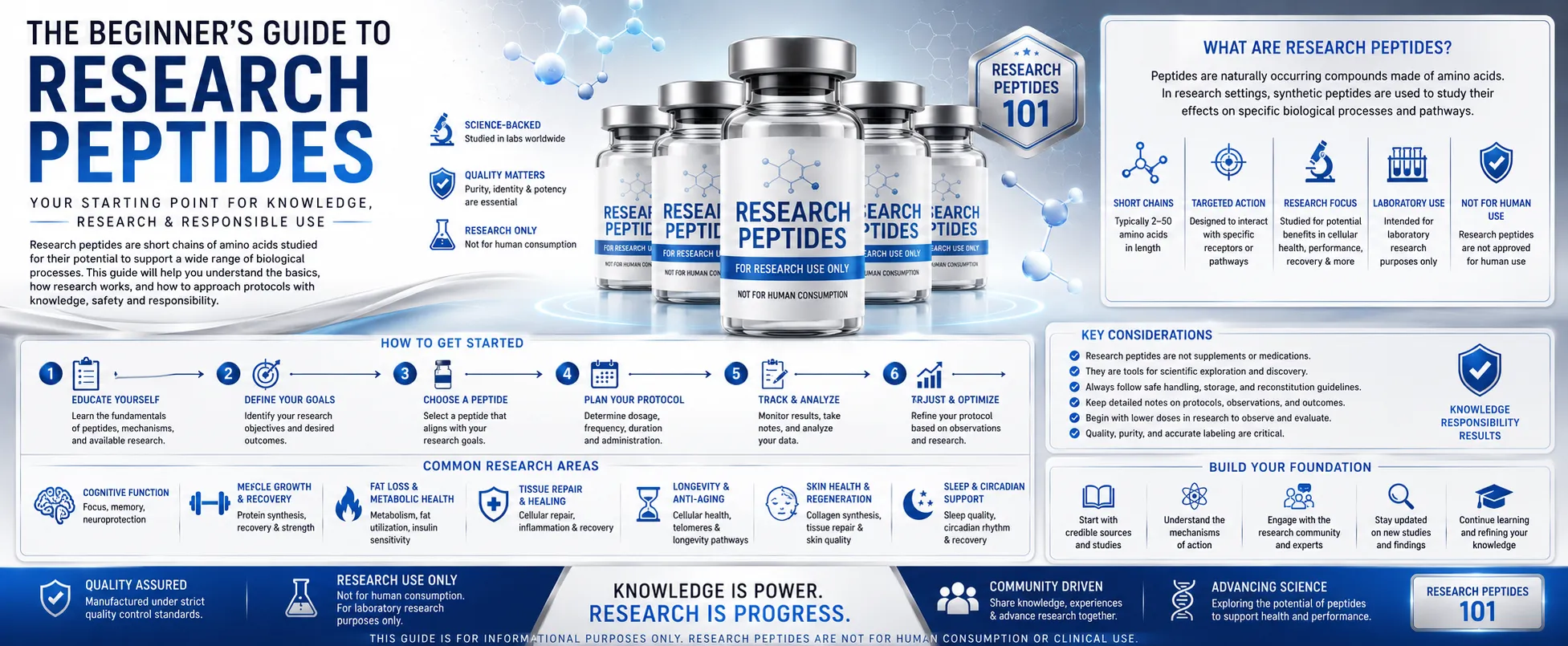
Beginner's Guide to Research Peptides: 2026 Edition
This reference is strictly for laboratory and in vitro research purposes. Not for human or animal consumption. Not a medicine, food, cosmetic, or dietary supplement. Not approved by the MHRA.
What Are Research Peptides?
Research peptides are short chains of amino acids (typically 2–50 residues) synthesised in laboratories for scientific investigation. Unlike pharmaceutical drugs, they are manufactured as reference materials for in vitro and laboratory animal studies — not for human consumption or clinical use.
Peptides occur naturally in the body as signalling molecules: insulin, growth hormone, and glucagon are all peptides. Synthetic research peptides mimic or modulate these natural pathways, allowing scientists to study cellular signalling, metabolic regulation, tissue repair, and ageing mechanisms in controlled settings.
For UK buyers, research peptides are legal to purchase for legitimate laboratory use. They are not controlled substances under the Misuse of Drugs Act 1971, nor are they licensed medicines under the MHRA. This guide explains everything a first-time buyer needs to know to make informed, safe decisions.
The Four Main Research Areas
Research peptides are generally grouped into four categories based on their primary research applications. Understanding these categories helps you choose the right compound for your model.
1. Metabolic Research
Peptides in this category are studied in glucose regulation, insulin secretion, receptor signalling, and energy homeostasis. Common examples include:
- Semaglutide — GLP-1 receptor agonist for sustained incretin signalling
- Tirzepatide — Dual agonist (GLP-1 / GIP) for glucose-dependent insulin secretion and energy homeostasis
- Retatrutide — Triple agonist (GLP-1 / GIP / glucagon) for multi-receptor metabolic studies
- MOTS-C — Mitochondrial-derived peptide for AMPK activation and metabolic flexibility
- Tesamorelin — GHRH analogue for growth hormone axis studies
2. Recovery & Healing Research
These peptides are studied in tissue regeneration, wound healing, and connective tissue repair models:
- BPC-157 — Pentadecapeptide investigated for angiogenesis and fibroblast activation
- TB-500 — Thymosin Beta-4 fragment for actin regulation and cell migration
- GHK-Cu — Copper tripeptide for extracellular matrix remodelling and collagen synthesis
3. Longevity & Anti-Aging Research
Longevity peptides examine cellular senescence, telomere maintenance, and mitochondrial function:
- Epithalon — Tetrapeptide studied for telomerase activation
- NAD+ — Coenzyme for redox metabolism and sirtuin activation
4. Cognitive & Neuro Research
These compounds are used in neuroimmune, stress-response, and synaptic plasticity models:
- Selank — Synthetic heptapeptide for neuroimmune modulation and BDNF expression
Most first-time researchers start with either metabolic or regenerative peptides, as these have the most published literature and established cellular models.
How to Choose Your First Peptide
Selecting your first peptide depends on three factors: your research model, your budget, and the depth of available literature.
Step 1: Define Your Research Question
- Are you studying metabolic pathways? → Consider Semaglutide, Tirzepatide, or Retatrutide
- Are you studying tissue repair or wound healing? → Consider BPC-157 or GHK-Cu
- Are you studying cellular ageing? → Consider Epithalon or NAD+
- Are you studying neuroimmune signalling? → Consider Selank
Step 2: Check Published Literature
Before ordering, search PubMed for your peptide + your cell type. For example:
- "BPC-157 fibroblast" → 50+ studies
- "Semaglutide MIN6" → 30+ studies
- "GHK-Cu collagen synthesis" → 40+ studies
A well-studied peptide gives you established protocols, positive controls, and reproducible endpoints.
Step 3: Start with a Single Compound
Beginners should avoid multi-peptide stacks until they are comfortable with reconstitution, storage, and assay design. Order one peptide, master the basics, then expand.
Step 4: Order the Right Size
- 10 mg is the standard starter size for most peptides
- 5 mg is available for some compounds if you want to test before scaling up
- Bacteriostatic water is essential for reconstitution — add a 3 ml vial to your order
Recommended First-Time Orders
| Research Focus | Peptide | Size | Why Start Here |
|---|---|---|---|
| Metabolic | Semaglutide | 10 mg | Well-documented, extensive cellular models |
| Metabolic | Tirzepatide | 5 mg | Dual agonist with unique GLP-1/GIP crosstalk data |
| Regenerative | BPC-157 | 10 mg | High purity, robust fibroblast literature |
| Skin / Matrix | GHK-Cu | 50 mg | Affordable, stable, visual confirmation (blue-violet) |
| Longevity | NAD+ | 500 mg | Simple reconstitution, clear enzymatic assays |
Understanding Purity and Quality
Purity is the most important parameter for reproducible research. Impurities can confound results, alter cellular responses, and invalidate your conclusions.
What the Numbers Mean
- ≥95%: Acceptable for preliminary screening and high-throughput assays
- ≥98%: Standard for most published research and cell culture work
- ≥99%: Preferred for sensitive assays (receptor binding, crystallography, NMR)
How Purity Is Measured
- HPLC (High-Performance Liquid Chromatography): Separates the target peptide from synthesis by-products. The area-under-curve percentage is the purity value.
- Mass Spectrometry (MS): Confirms the molecular weight and sequence identity. Always verify that the observed mass matches the theoretical mass within ±1 Da.
What to Demand from Your Supplier
- Certificate of Analysis (CoA) per batch, showing HPLC chromatogram and MS data
- Batch-specific testing — not a generic template
- Endotoxin levels <0.5 EU/mL for cell culture safety
- Molecular weight confirmation matching the theoretical value
Red Flags
- No batch number on the CoA
- No analytical method details (e.g., "purity >95%" without HPLC method)
- No mass spectrometry data
- Outdated analysis date relative to the batch
- No analyst signature or reviewer stamp
Best Practice: Retain the CoA for every batch. If you publish results, include the batch number, supplier, and purity grade in your methods section.
Reconstitution Basics
Reconstitution is the process of dissolving lyophilised (freeze-dried) peptide powder into a liquid solution for laboratory use. It is simpler than it sounds, but precision matters.
What You Need
- Bacteriostatic water (BAC water) — sterile water with 0.9% benzyl alcohol
- Sterile syringe (1–3 ml) with 25G or 27G needle
- Alcohol wipes (70% isopropyl)
- Vial stand or rack
Basic Steps
- Allow the peptide vial and BAC water to reach room temperature
- Wipe both stoppers with an alcohol wipe; let dry
- Draw the required volume of BAC water into the syringe
- Inject the water slowly down the inside wall of the peptide vial — do not spray directly onto the powder
- Gently swirl the vial until the powder dissolves. Do not shake vigorously
- Inspect the solution: it should be clear and free of particles
Concentration Quick Reference
For a 10 mg vial:
- 1 ml water = 10 mg/ml
- 2 ml water = 5 mg/ml
- 5 ml water = 2 mg/ml
Choose a concentration appropriate for your assay. Higher concentrations are not always better — some peptides become less soluble above 5 mg/ml.
Troubleshooting
- Won't dissolve? Gently warm to 25–30°C (never exceed 37°C) or add water in smaller increments
- Cloudy solution? The concentration may be too high; dilute with more BAC water
- Foam formed? Caused by shaking or forceful injection. Let it settle; do not shake to disperse
For a detailed protocol, see our Peptide Reconstitution Guide.
Storage and Handling
Proper storage preserves peptide integrity and ensures reproducible results.
Lyophilised Powder (Unopened)
- Store at −20°C in a desiccated container
- Protect from light (amber vials or foil wrapping)
- Shelf life: 24–36 months when properly stored
- Avoid frost-free freezers (temperature cycling degrades peptides)
Reconstituted Solution
- Store at 2–8°C (refrigerator)
- Use bacteriostatic water for multi-day storage (prevents bacterial growth)
- Shelf life: 7–14 days under refrigeration
- Protect from light
- Never freeze-thaw repeatedly — causes aggregation and pH shifts
Critical Precautions
- Wear powder-free gloves when handling vials
- Wipe the stopper with alcohol before every needle insertion
- Use a new sterile needle for each access
- Label the vial with peptide name, concentration, and reconstitution date
- Document all handling in your laboratory notebook
Light-Sensitive Peptides
- GHK-Cu: The copper complex is photoreduced by visible light; store in amber vials or wrapped in foil
- Tryptophan-containing peptides: Oxidise under UV light
- Methionine-containing peptides: Susceptible to photo-oxidation
For comprehensive storage guidance, see our Storage and Handling Guide.
UK Legal Status and Compliance
Research peptides operate in a specific regulatory framework in the UK. Understanding this framework protects you and ensures your research remains compliant.
Legal Status
- Not controlled substances under the Misuse of Drugs Act 1971
- Not scheduled under the Psychoactive Substances Act 2016
- Not licensed as medicines by the MHRA
- Classified as research reference materials for laboratory use
What This Means for Buyers
- You do not need a prescription or licence to purchase research peptides
- You must use them for in vitro and laboratory research only
- You must not consume them, administer them to animals without ethical approval, or market them as medicines
For Animal Research
If you plan to use peptides in animal studies, you must obtain:
- Institutional Animal Care and Use Committee (IACUC) or equivalent approval
- Compliance with the Animals (Scientific Procedures) Act 1986
- Veterinary oversight and appropriate dosing protocols
Importing Peptides
Importing research peptides for laboratory use is permitted under UK customs regulations, provided:
- The peptides are for genuine research
- The quantity is appropriate for research (not commercial resale)
- The materials are properly declared
- You retain all import documentation (invoices, CoAs, batch records)
Research-Use-Only Labelling
All legitimate UK suppliers label peptides explicitly for research use. If a supplier markets peptides for human consumption, cosmetic use, or as dietary supplements, they are operating outside UK regulations and should be avoided.
Common Beginner Mistakes
Avoiding these common errors will save you money, time, and failed experiments.
1. Buying from Unverified Suppliers
The UK peptide market includes vendors with questionable quality control. Always verify:
- Batch-specific CoAs with HPLC and MS data
- UK-based testing or clear traceability
- Responsive customer support
- Transparent pricing (no hidden fees)
If a price seems too good to be true, the purity probably is too.
2. Choosing the Wrong Purity Grade
- Mistake: Buying 95% purity for a sensitive cell culture assay
- Fix: Use ≥98% for cell culture, ≥99% for receptor binding or crystallography
- Exception: Screening and antibody generation can tolerate 95%
3. Using the Wrong Solvent
- Mistake: Reconstituting with tap water or distilled water
- Fix: Use bacteriostatic water for multi-day storage; sterile water only for same-day use
- Mistake: Using PBS for long-term storage (no preservative)
4. Storing Improperly
- Mistake: Leaving reconstituted peptides at room temperature for days
- Fix: Refrigerate at 2–8°C immediately after reconstitution
- Mistake: Repeated freeze-thaw of reconstituted solutions
- Fix: Aliquot into single-use vials before freezing
5. Skipping Documentation
- Mistake: Not recording batch numbers, reconstitution dates, or storage conditions
- Fix: Maintain a laboratory notebook. This is essential for reproducibility and regulatory compliance.
6. Ordering Without a Clear Research Plan
- Mistake: Buying a peptide because it is popular, not because it fits your model
- Fix: Search PubMed for your cell type + peptide before ordering. Confirm that published protocols exist.
7. Ignoring the CoA
- Mistake: Throwing away the Certificate of Analysis
- Fix: Retain the CoA for every batch. Verify the molecular weight and purity independently if publishing results.
Frequently Asked Questions
References
- [1] Merrifield RB. Solid phase peptide synthesis. I. The synthesis of a tetrapeptide. J Am Chem Soc 1963;85:2149-2154.
- [2] Fields GB, Noble RL. Solid phase peptide synthesis utilizing 9-fluorenylmethoxycarbonyl amino acids. Int J Pept Protein Res 1990;35:161-214.
- [3] UK Home Office. Misuse of Drugs Act 1971. Legislation.gov.uk.
- [4] Medicines and Healthcare products Regulatory Agency (MHRA). Human Medicines Regulations 2012.
- [5] Animals (Scientific Procedures) Act 1986. Legislation.gov.uk.
For laboratory and in vitro research use only. Not for human consumption. Not a medicine. Nothing in this article constitutes medical advice. UK researchers are responsible for compliance with the Human Medicines Regulations 2012 and Misuse of Drugs Regulations 2001 where applicable.