
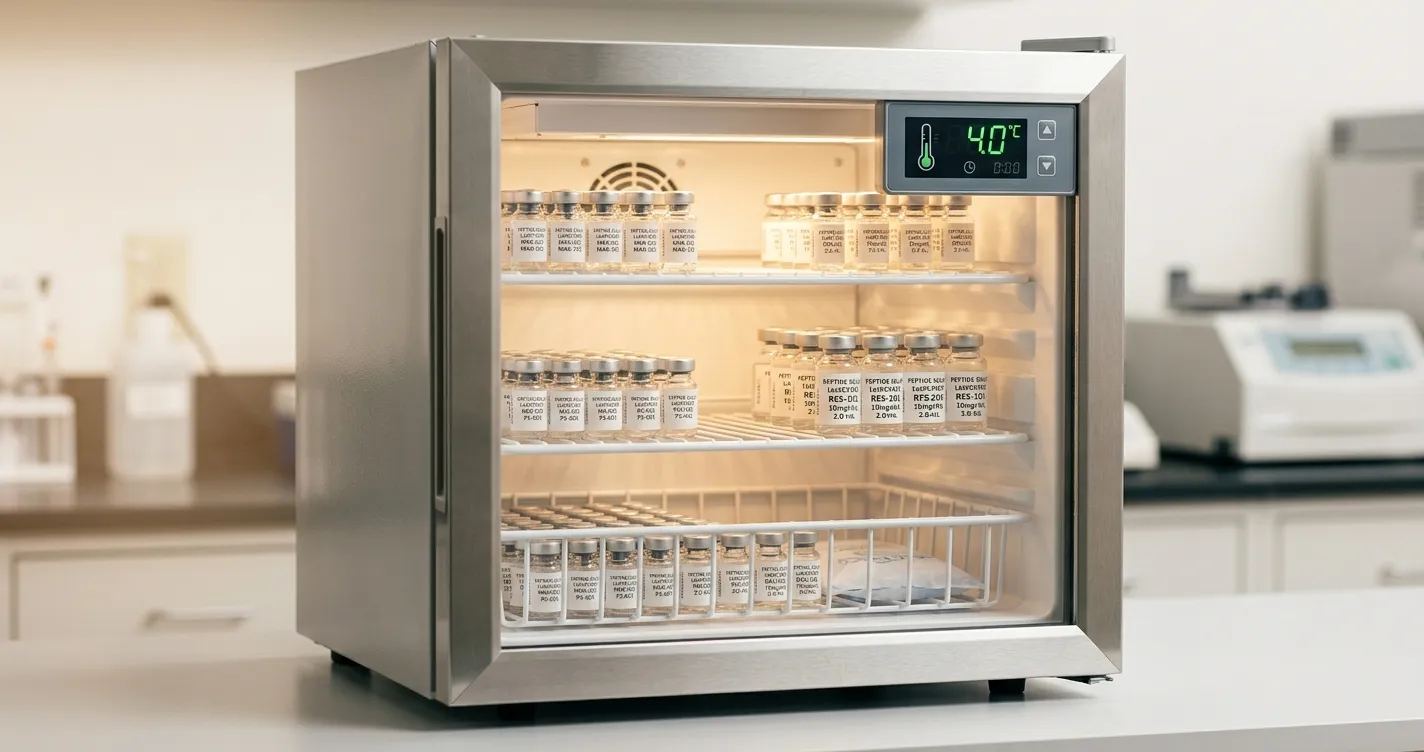
Peptide Storage and Handling Best Practices for Laboratories
This guide is strictly for laboratory and in vitro research purposes. Not for human or animal consumption. Not a medicine, food, cosmetic, or dietary supplement. Not approved by the MHRA.
Overview
Peptide stability is a critical factor in research reproducibility. Improper storage can lead to degradation, oxidation, aggregation, and loss of biological activity, compromising experimental results. This guide provides evidence-based storage and handling protocols for both lyophilised (powder) and reconstituted (liquid) peptides in research settings.
Key principles:
- Temperature: Lower temperatures slow degradation reactions
- Desiccation: Moisture promotes hydrolysis and aggregation
- Light protection: UV light causes photodegradation and oxidation
- Minimise handling: Every manipulation introduces contamination risk
- Documentation: Record all storage conditions and handling dates
Storing Lyophilised (Powder) Peptides
Lyophilised peptides are the most stable form and should be stored under the following conditions:
Recommended Storage:
- Temperature: −20 °C (standard freezer) or −80 °C (ultra-low freezer)
- Desiccation: Store in a sealed container with desiccant (silica gel or molecular sieve)
- Light: Protect from light using amber vials or foil wrapping
- Atmosphere: Minimise air exposure (oxygen promotes oxidation)
Shelf Life:
- At −20 °C, desiccated, and protected from light: 24–36 months (manufacturer-stated; may be longer)
- At −80 °C: 36+ months (ultra-low temperatures virtually halt degradation)
- At room temperature (25 °C): 1–3 months (acceptable for short-term use only)
Best Practices:
- Store vials in airtight containers with fresh desiccant
- Use a dedicated freezer box to protect from temperature fluctuations
- Label each vial with peptide name, batch number, and storage date
- Maintain a freezer inventory log
- Do not store peptides in frost-free freezers (temperature cycling promotes degradation)
Freeze-Thaw Cycles:
- Lyophilised powder is relatively resistant to freeze-thaw cycles
- However, minimise cycles by planning experiments and removing only the required vials
- Allow vials to reach room temperature before opening to prevent condensation
Storing Reconstituted (Liquid) Peptides
Reconstituted peptides are less stable than lyophilised powder and require careful handling:
Recommended Storage:
- Temperature: 2–8 °C (refrigerator)
- Light: Protect from light (amber vials or foil wrapping)
- pH: Maintain at pH 6.5–7.5 for most peptides
- Container: Use sterile, sealed vials; avoid repeated opening
Shelf Life:
- In bacteriostatic water at 2–8 °C: 7–14 days
- In sterile water at 2–8 °C: 24 hours (no preservative)
- In DMSO or organic solvents: 30–90 days (depends on solvent)
- Frozen aliquots at −20 °C: 3–6 months (single-use aliquots only)
Critical Precautions:
- Never freeze-thaw reconstituted peptides repeatedly: This causes aggregation and pH shifts
- Aliquot into single-use vials if long-term storage is needed
- Monitor for precipitation: Cloudiness or particles indicate degradation
- Check pH periodically: pH drift can accelerate hydrolysis
Light-Sensitive Peptides:
Some peptides are particularly light-sensitive and require extra protection:
- GHK-Cu: Copper complex is photoreduced by visible light; store in amber vials or wrapped in foil
- Tryptophan-containing peptides: Tryptophan oxidises under UV light
- Methionine-containing peptides: Methionine is susceptible to photo-oxidation
Temperature-Sensitive Peptides:
- Short peptides (<10 amino acids): Generally stable at 2–8 °C
- Long peptides (>30 amino acids): May require −20 °C for extended storage
- Cyclic peptides: Often more stable than linear peptides due to conformational rigidity
Handling Protocols
Proper handling is as important as proper storage. Follow these protocols to maintain peptide integrity:
Glove Handling:
- Always wear powder-free nitrile or latex gloves when handling peptide vials
- Avoid touching the vial stopper or inside of the cap
- Change gloves between handling different peptides to prevent cross-contamination
Vial Opening:
- Wipe the rubber stopper with 70% isopropyl alcohol before inserting needles
- Use a new sterile needle for each access
- Minimise the number of needle punctures (each puncture introduces contamination risk)
- For frequent access, consider using a septum vial or divided aliquots
Reconstitution:
- Allow vials to reach room temperature before opening (prevents condensation)
- Use bacteriostatic water for any storage beyond 24 hours
- Inject water slowly down the vial wall (avoid spraying onto powder)
- Do not shake vigorously; gentle swirling is sufficient
Transportation:
- Use insulated containers with cold packs for transport
- Maintain temperature logs during transit
- For international shipping, use dry ice or gel packs with appropriate documentation
- Avoid temperature extremes (>30 °C or <−80 °C during transit)
Disposal:
- Dispose of expired or degraded peptides in accordance with institutional hazardous waste protocols
- Do not pour peptides down the drain
- Needles and vials go in sharps containers
Monitoring Stability and Degradation
Researchers should monitor peptide stability over time, especially for long-term storage:
Visual Inspection:
- Lyophilised powder: Should be white or off-white, fluffy, and free-flowing
- Reconstituted solution: Should be clear and colourless (or appropriate colour for the peptide)
- Signs of degradation: Yellowing, browning, cloudiness, precipitation, or unusual odour
Analytical Monitoring:
- HPLC check: Run a quick analytical HPLC after 30 days of storage to compare to the original CoA
- Mass spectrometry: Verify molecular weight after extended storage
- Bioactivity assay: If a standard assay exists, confirm activity periodically
Common Degradation Pathways:
- Hydrolysis: Cleavage of peptide bonds by water; accelerated at acidic or basic pH
- Oxidation: Methionine, cysteine, and tryptophan residues are most susceptible
- Deamidation: Asparagine and glutamine residues convert to aspartic acid and glutamic acid
- Aggregation: Hydrophobic peptides may form fibrils or precipitates
- Racemisation: D-amino acid formation at high pH or temperature
Accelerated Stability Testing:
For critical experiments, researchers can perform accelerated stability testing:
- Store peptide at 37 °C for 7 days
- Compare HPLC and bioactivity to the original sample
- Extrapolate shelf life using the Arrhenius equation (Q10 rule: reaction rate doubles for every 10 °C increase)
Example: If a peptide is stable at 37 °C for 7 days, it is likely stable at 2–8 °C for ~70–140 days (10–20× longer).
Compliance and Documentation
UK research laboratories must maintain proper documentation for regulatory compliance and reproducibility:
Required Records:
- Receipt log: Date received, supplier, batch number, condition upon arrival
- Storage log: Freezer/refrigerator location, temperature monitoring records, desiccant changes
- Handling log: Dates opened, reconstituted, aliquoted, and used
- Stability data: HPLC checks, visual inspections, and bioactivity confirmations
- Disposal log: Date, quantity, and method of disposal
Temperature Monitoring:
- Use continuous temperature loggers (e.g., digital data loggers) in freezers and refrigerators
- Record minimum and maximum temperatures daily
- Investigate and document any temperature excursions
- Maintain a temperature alarm system for critical storage units
Regulatory Notes:
- Research peptides are not controlled substances under the Misuse of Drugs Act 1971 (unless specifically scheduled)
- They are not medicines under the Human Medicines Regulations 2012
- Research institutions must comply with their own ethics review boards and institutional safety protocols
- Proper documentation supports audit readiness and legal compliance
Frequently Asked Questions
Browse our catalog of research-grade peptide reference materials. All products include batch-specific Certificates of Analysis and are shipped from the UK.
For laboratory and in vitro research use only. Not for human consumption. Not a medicine. Nothing in this guide constitutes medical advice. UK researchers are responsible for compliance with the Human Medicines Regulations 2012 and Misuse of Drugs Regulations 2001 where applicable.