
Use our reconstitution calculator to calculate concentrations, volumes, and dosages instantly.
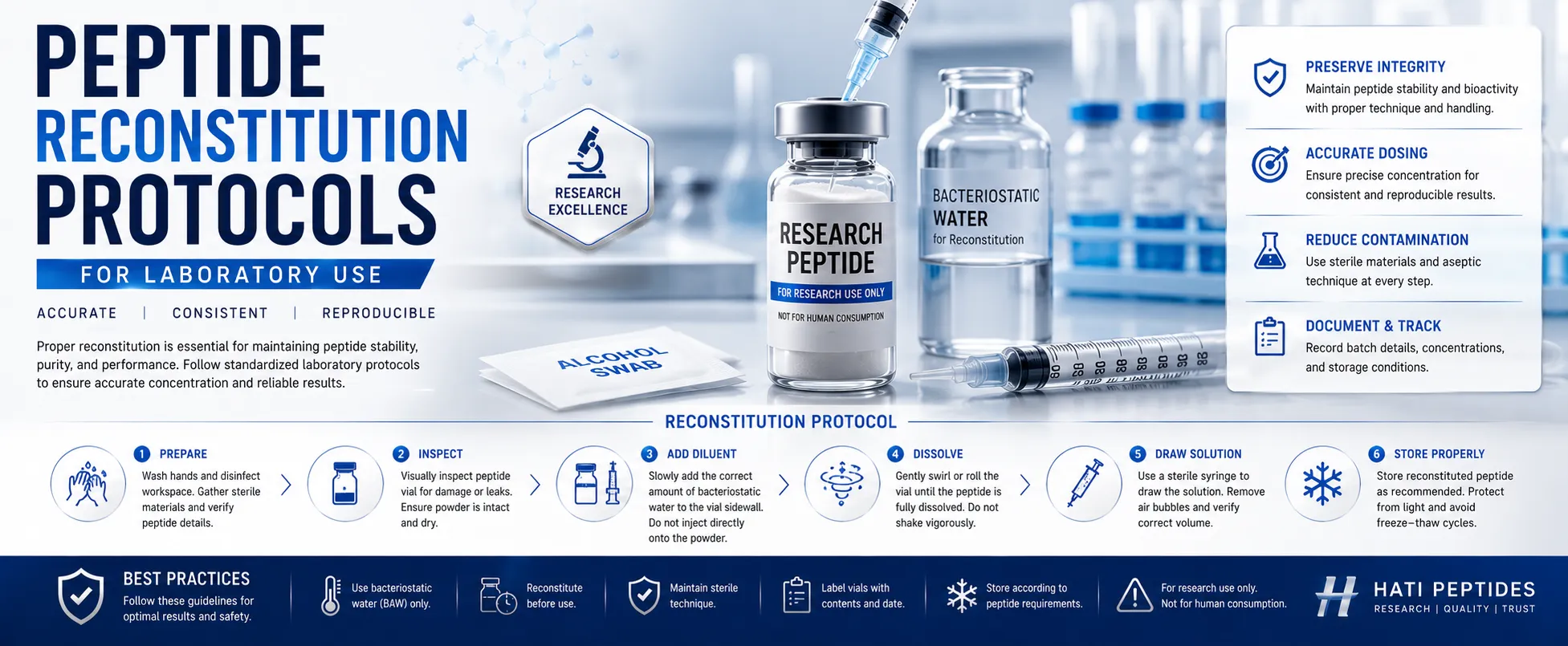
Peptide Reconstitution Protocols for Laboratory Use
This guide is strictly for laboratory and in vitro research purposes. Not for human or animal consumption. Not a medicine, food, cosmetic, or dietary supplement. Not approved by the MHRA.
What Is Reconstitution?
Reconstitution simply means mixing the freeze-dried peptide powder with water so it becomes a liquid you can work with. The powder arrives in the vial because it is more stable that way — once you add water, the clock starts ticking on freshness.
This guide covers how to do it properly: what you need, the exact steps, and what to do if something goes wrong. Read it once before you start so you do not waste a vial.
All peptides sold by Hati Peptides are for in vitro research only. They are not for human or animal use.
What You Need
You only need four things:
- Bacteriostatic water (BAC water) — This is sterile water with 0.9% benzyl alcohol that stops bacteria growing. It is the standard liquid used for mixing peptides. Do not use tap water, distilled water, or bottled water.
- A sterile syringe and needle — A 1 mL or 3 mL syringe with a 25G or 27G needle works fine. You can buy these online from medical supply shops in the UK.
- Alcohol wipes — 70% isopropyl alcohol wipes for cleaning the rubber tops of the vials.
- A clean, flat surface — A kitchen counter wiped down with disinfectant is fine. Wash your hands first.
That is it. You do not need a laboratory, pH strips, a vortex mixer, or any special equipment.
Step-by-Step: Mixing Your Peptide
Follow these steps in order. Do not rush it — the most common mistakes happen when people inject water too fast or shake the vial.
Step 1: Let the vials warm up
Leave both the peptide vial and the BAC water vial on the counter for 10–15 minutes until they reach room temperature. If they are cold from the fridge, condensation can form inside when you open them, which is not what you want.
Step 2: Clean the rubber tops
Wipe the rubber stopper on both vials with an alcohol wipe. Wait about 30 seconds for the alcohol to dry before you stick a needle in.
Step 3: Decide how much water to add
This determines how strong your solution is. Use this simple rule: Concentration = milligrams of peptide ÷ millilitres of water.
For a 10 mg vial:
- 10 mL water = 1 mg/mL
- 5 mL water = 2 mg/mL
- 2 mL water = 5 mg/mL
- 1 mL water = 10 mg/mL
For a 20 mg vial:
- 20 mL water = 1 mg/mL
- 10 mL water = 2 mg/mL
- 4 mL water = 5 mg/mL
- 2 mL water = 10 mg/mL
Most people use 2–5 mL for a 10 mg vial. That gives a concentration that is easy to measure with a standard syringe and dissolves reliably. If you make it too concentrated (e.g., 1 mL into 10 mg), some peptides will struggle to dissolve.
Step 4: Draw the water
Stick the needle through the rubber top of the BAC water vial and draw up the amount you decided on. Pull the needle out.
Step 5: Inject the water into the peptide vial
Insert the needle into the peptide vial at a slight angle so the tip touches the inside wall. Push the plunger slowly and let the water run down the glass onto the powder. Do not shoot the water straight onto the powder — this creates foam and can damage the peptide.
Step 6: Mix gently
Remove the needle. Swirl the vial slowly or roll it between your palms. Do not shake it. Most peptides dissolve within a couple of minutes. If the powder is still sitting there after 5 minutes, see the troubleshooting section below.
Step 7: Check the liquid
It should look clear with no visible particles. A very slight haze is fine for some peptides. If you see obvious floating bits or cloudiness, you probably made it too concentrated — add a bit more BAC water and swirl again.
Step 8: Label and store
Write on the vial or a sticker:
- Peptide name
- How much you put in (e.g., "2 mg/mL")
- The date you mixed it
Put the vial in the fridge (2–8 °C) and keep it away from light. Keep it as powder in the freezer until you are ready to use it — powder is far more stable than liquid.
If Something Goes Wrong
The powder will not dissolve
- Make sure the vial is at room temperature. Cold peptides dissolve slower.
- Try rolling the vial between your palms for a few minutes. Gentle warmth helps.
- If it still will not dissolve, your concentration is probably too high. Add more BAC water and try again.
- Some peptides (like BPC-157) can take 10–15 minutes to fully dissolve. Be patient.
The liquid looks cloudy or has bits floating in it
- This usually means the concentration is too high. Add more BAC water and swirl again.
- Some peptides (like GHK-Cu) naturally have a slight blue or purple tint. That is normal.
- If it stays cloudy even after diluting, contact us with your batch number and we will sort it out.
There is foam on top
- You either shook the vial or injected the water too quickly. Let it sit for 5–10 minutes — the foam will settle. The peptide is usually fine, but next time inject slower and do not shake.
I used the wrong amount of water
- If you used too much, the concentration is just lower. That is fine — you will need to draw more liquid to get the same dose. Use the calculator on our site to work out the new numbers.
- If you used too little and the peptide will not dissolve, add more water gradually until it clears.
Safety Basics
- Work on a clean surface — Wipe the area down first. Wash your hands. This is basic hygiene, not laboratory sterility.
- Wear gloves — Nitrile or latex gloves protect both you and the peptide. Avoid touching the rubber stopper with bare fingers.
- Do not ingest or inject — Research peptides are not tested for human safety. They are not medicines. Handle them only in a research context.
- Dispose of needles safely — Put used syringes and needles in a rigid container (an old plastic bottle or a proper sharps bin) and take them to a pharmacy for disposal. Do not put loose needles in household waste.
- Keep away from children and pets — Store peptides in a locked fridge or a secure box, especially if you have children at home.
Frequently Asked Questions
Browse our catalog of research-grade peptide reference materials. All products include batch-specific Certificates of Analysis and are shipped from the UK.
For laboratory and in vitro research use only. Not for human consumption. Not a medicine. Nothing in this guide constitutes medical advice. UK researchers are responsible for compliance with the Human Medicines Regulations 2012 and Misuse of Drugs Regulations 2001 where applicable.