
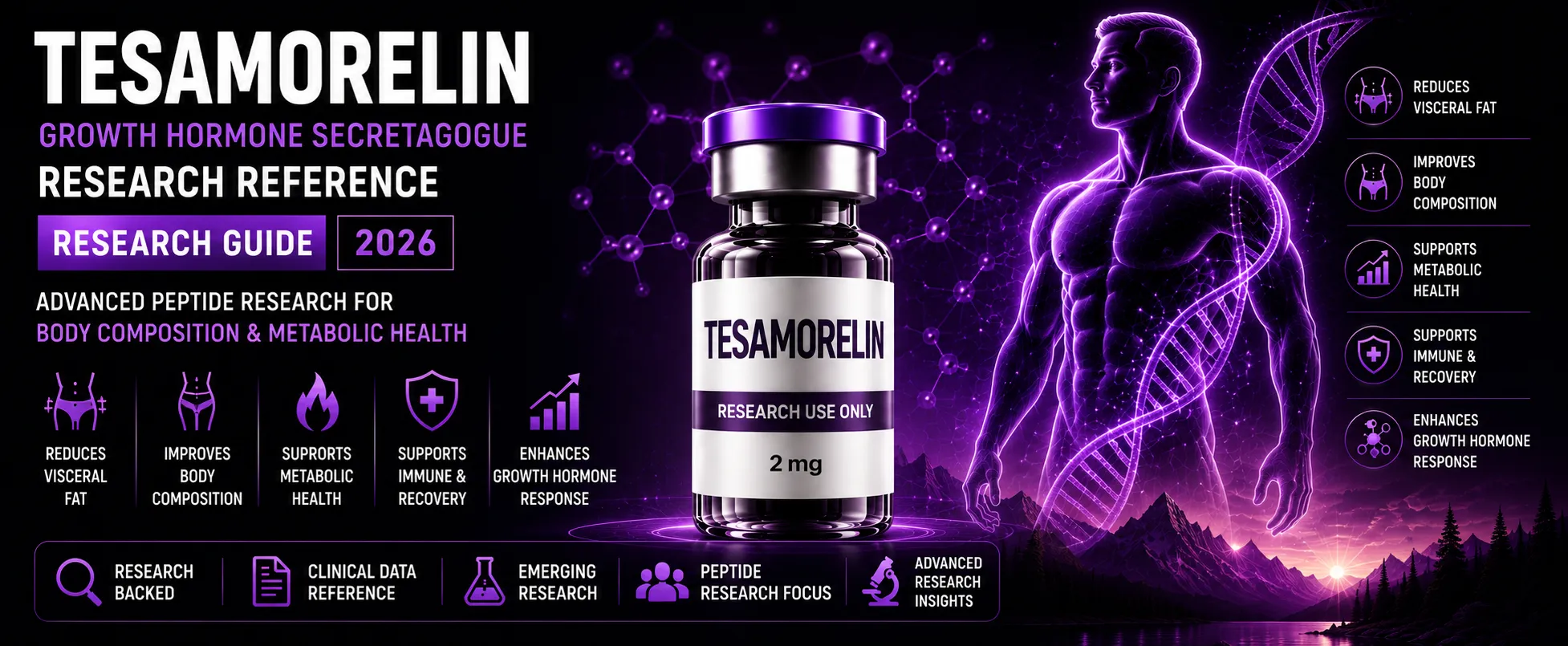
Tesamorelin UK: Research Reference 2026
This reference is strictly for laboratory and in vitro research purposes. Not for human or animal consumption. Not a medicine, food, cosmetic, or dietary supplement. Not approved by the MHRA.
Overview
Tesamorelin is a synthetic 44-amino-acid peptide analogue of human growth hormone-releasing hormone (GHRH). The peptide is designed to stimulate endogenous growth hormone secretion through activation of the GHRH receptor in the pituitary gland.
The structure is based on the native GHRH(1-44) sequence with a trans-3-hexenoic acid group attached to the tyrosine residue at position 1, which protects the N-terminus from degradation and extends the peptide's half-life compared to native GHRH.
For UK research laboratories, tesamorelin serves as a reference compound for studies examining growth hormone physiology, metabolic regulation, and the role of the GHRH-GH-IGF-1 axis in cellular and systemic metabolism.
Molecular Structure
Tesamorelin is a 44-amino-acid peptide with specific structural modifications:
- Sequence: 44 amino acids (human GHRH 1-44)
- Molecular weight: Approximately 5,135 Da
- Modification: Trans-3-hexenoic acid group attached to the tyrosine residue at position 1
- Half-life: Extended compared to native GHRH due to N-terminal protection
- Receptor: GHRH receptor (GHRHR) in the anterior pituitary
The trans-3-hexenoic acid modification is critical for the peptide's stability. Native GHRH is rapidly degraded by dipeptidyl peptidase IV (DPP-IV), which cleaves after the second amino acid. The N-terminal modification protects this cleavage site, extending the peptide's biological half-life from minutes to hours.
Mechanism of Action
Tesamorelin operates through the following mechanism in research models:
GHRH Receptor Activation
Tesamorelin binds to the GHRH receptor (GHRHR), a Gs-coupled GPCR located on somatotroph cells in the anterior pituitary. Receptor activation increases intracellular cAMP, leading to protein kinase A activation and stimulation of growth hormone gene transcription and secretion. In cellular models, GHRH receptor activation triggers pulsatile growth hormone release.
Growth Hormone Axis Stimulation
The primary effect of tesamorelin is stimulation of endogenous growth hormone secretion. In research models, this leads to increased circulating GH levels, which subsequently stimulates hepatic IGF-1 production. The GH-IGF-1 axis regulates metabolism, body composition, and cellular growth.
Metabolic Effects
Through the GH-IGF-1 axis, tesamorelin influences multiple metabolic pathways: increased lipolysis and free fatty acid availability, enhanced protein synthesis, and modulation of glucose metabolism. In cellular studies, GH and IGF-1 stimulate lipolysis in adipocytes, protein synthesis in myocytes, and gluconeogenic gene expression in hepatocytes.
Body Composition
Growth hormone is lipolytic and anabolic, increasing fat mobilisation while supporting lean tissue preservation. In cellular and animal models, tesamorelin's effects on body composition are mediated through GH receptor signalling in adipose tissue, muscle, and liver.
Research Applications
Tesamorelin is employed across multiple research domains in UK laboratories:
Endocrine Research
In vitro studies examine tesamorelin's effects on pituitary somatotroph function, GH secretion patterns, and the regulation of the GH-IGF-1 axis. Researchers use the peptide to study GHRH receptor pharmacology, signal transduction, and the feedback mechanisms controlling growth hormone secretion.
Metabolic Disease Research
Cellular models examine tesamorelin's effects on lipid metabolism, glucose homeostasis, and insulin sensitivity. The GH-IGF-1 axis influences multiple metabolic pathways, creating research questions about the balance between lipolytic and insulin-antagonistic effects.
Body Composition Studies
In cellular and animal models, tesamorelin is studied in the context of fat distribution, lean mass preservation, and visceral adiposity. The peptide's lipolytic effects are examined in adipocyte cultures, while anabolic effects are studied in myocyte models.
Ageing Research
Growth hormone declines with age, and tesamorelin is used in cellular models to examine the effects of restoring GH axis activity. Research questions address whether GHRH stimulation can restore youthful metabolic patterns in aged cells and tissues.
Comparative GH Secretagogues
Tesamorelin is compared to other GH secretagogues (GHRP-2, GHRP-6, ipamorelin) in cellular and animal studies. Research questions examine whether GHRH-based stimulation differs from ghrelin-mimetic approaches in terms of GH secretion patterns, metabolic effects, and receptor selectivity.
Cellular and In Vitro Models
UK research laboratories employ several standard cellular models for tesamorelin studies:
Pituitary Cell Cultures
Primary pituitary cells and GH3 rat pituitary tumour cells are used to measure GH secretion in response to tesamorelin. Endpoints include GH release (RIA or ELISA), cAMP accumulation, and intracellular calcium signalling. The GHRH receptor specificity is confirmed using GHRH antagonists.
Adipocyte Metabolism
3T3-L1 adipocytes and primary human adipocytes are used to examine GH-mediated lipolysis. Endpoints include glycerol release, hormone-sensitive lipase phosphorylation, and adipokine secretion. Tesamorelin's effects are compared to direct GH treatment.
Hepatocyte IGF-1 Production
Primary hepatocytes and hepatoma cell lines are used to measure GH-stimulated IGF-1 production. Endpoints include IGF-1 secretion (ELISA), IGFBP production, and STAT5 signalling. The transcriptional response to GH receptor activation is quantified.
Myocyte Protein Synthesis
C2C12 myotubes and primary muscle cells are used to examine GH-IGF-1-mediated protein synthesis. Endpoints include amino acid uptake, protein synthesis rates (puromycin incorporation), and mTOR signalling.
Safety Profile in Preclinical Research
Tesamorelin's safety profile is based on preclinical cellular and animal studies. In vitro toxicology screens have not identified significant cytotoxicity at research-relevant concentrations.
In animal studies, the primary effects are consistent with GH axis stimulation: increased IGF-1 levels, lipolysis, and protein synthesis. No organ-specific toxicity has been reported at standard research doses. The peptide's specificity for the GHRH receptor minimises off-target effects.
Theoretical considerations include GH-mediated insulin resistance, fluid retention, and joint effects, though these are generally observed at supraphysiological GH levels. Standard research doses are designed to restore physiological GH patterns rather than supraphysiological stimulation.
Standard laboratory precautions apply: tesamorelin is a research peptide, not a medicine or dietary supplement. It is supplied for in vitro and laboratory animal research only.
Reconstitution and Handling
Tesamorelin is supplied as a lyophilised powder in research-grade vials. Standard laboratory preparation:
- Reconstitution: Bacteriostatic water (0.9% benzyl alcohol) is recommended for laboratory preparations
- Concentration: Typical research stock concentrations range from 1–10 mg/mL depending on assay requirements
- Storage: Lyophilised powder at −20 °C; reconstituted solution at 2–8 °C, protected from light
- Stability: Reconstituted solutions are stable for 7–14 days under refrigeration; for extended studies, aliquot and freeze at −20 °C
- Solubility: The peptide is generally soluble in aqueous solutions; gentle vortexing may aid dissolution
- DPP-IV sensitivity: Although the N-terminal modification confers some protection, researchers should be aware of potential proteolytic degradation in serum-containing media
Peptide stability is pH-dependent; maintain solutions at pH 6.5–7.5. Avoid repeated freeze-thaw cycles.
UK Research Status
Tesamorelin is not a controlled substance under the UK Misuse of Drugs Act 1971 and is not scheduled under the Psychoactive Substances Act 2016. It is classified as a research peptide for laboratory use and is not licensed as a medicine by the MHRA.
For UK research laboratories, tesamorelin is available as a research-grade reference material. Sourcing should include:
- Certificate of Analysis confirming ≥98% purity (HPLC)
- Mass spectrometry identity confirmation (molecular weight ~5,135 Da)
- Batch-specific testing documentation
- Appropriate storage and shipping conditions (cold chain)
- Research-use-only labelling
Researchers should ensure compliance with institutional ethics approvals for animal studies, and adhere to standard laboratory safety protocols for peptide handling.
Frequently Asked Questions
References
- [1] Falutz J et al. Effects of tesamorelin, a growth hormone-releasing factor, in HIV-infected patients with abdominal fat accumulation. AIDS 2010;24:1269-1278.
- [2] Manso EL et al. Tesamorelin, a growth hormone-releasing factor analogue, for treatment of HIV-associated lipohypertrophy. Drugs Today 2010;46:851-863.
- [3] Stanley TL et al. Effects of tesamorelin on visceral fat and liver fat in HIV-infected patients. J Clin Endocrinol Metab 2012;97:3639-3649.
- [4] Biller BMK et al. Sensitivity of growth hormone secretion to apomorphine and growth hormone-releasing hormone. J Clin Endocrinol Metab 1992;74:440-444.
- [5] Ionescu M et al. Pulsatile administration of growth hormone-releasing hormone. Endocrine 2006;29:9-14.
For laboratory and in vitro research use only. Not for human consumption. Not a medicine. Nothing in this article constitutes medical advice. UK researchers are responsible for compliance with the Human Medicines Regulations 2012 and Misuse of Drugs Regulations 2001 where applicable.