
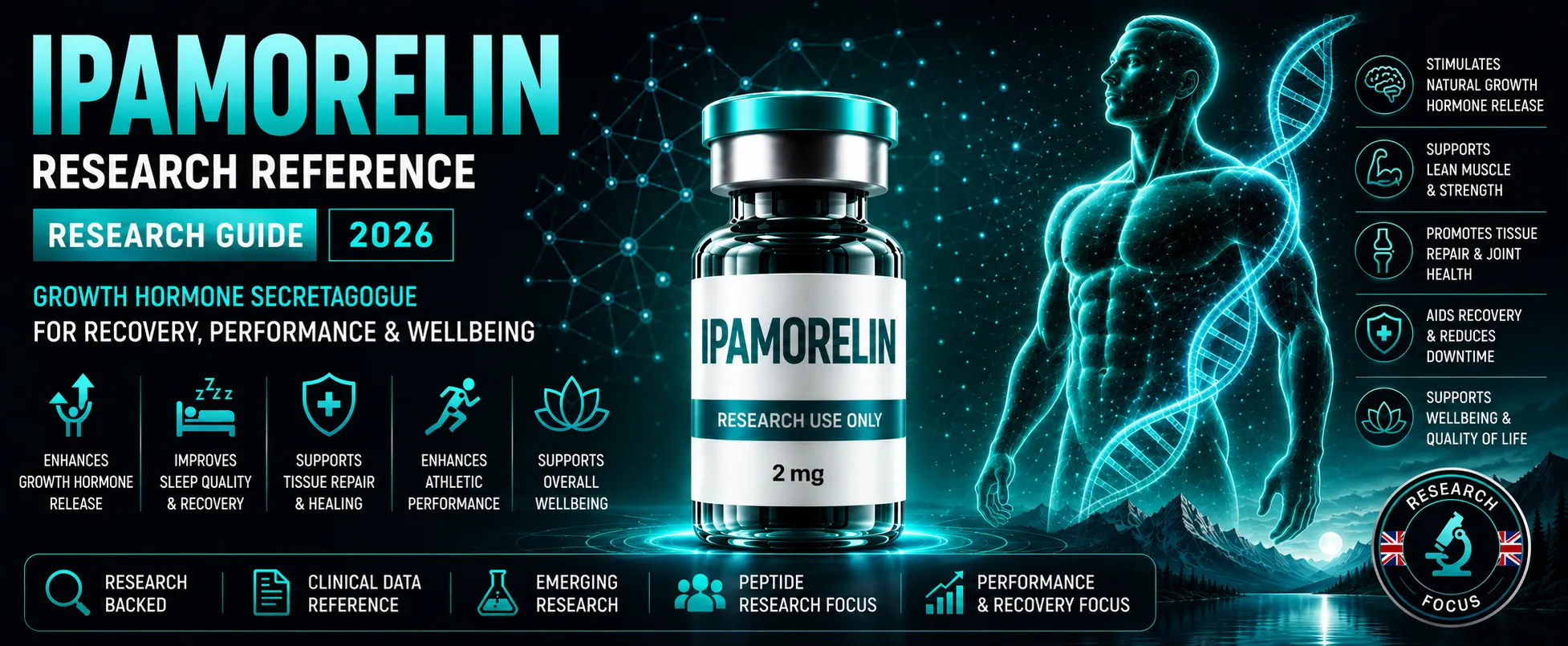
Ipamorelin UK: Research Reference 2026
This reference is strictly for laboratory and in vitro research purposes. Not for human or animal consumption. Not a medicine, food, cosmetic, or dietary supplement. Not approved by the MHRA.
Overview
Ipamorelin is a pentapeptide (Aib-His-D-2-Nal-D-Phe-Lys-NH2) that functions as a selective growth hormone secretagogue. The peptide stimulates growth hormone release through the ghrelin receptor (GHS-R1a) without significant stimulation of cortisol, prolactin, or other pituitary hormones.
The peptide was developed as a more selective alternative to earlier GH secretagogues (GHRP-2, GHRP-6) that produced broader pituitary hormone responses. Ipamorelin's selectivity for GH release makes it a valuable tool for research into isolated GH axis manipulation.
For UK research laboratories, ipamorelin serves as a reference compound for studies examining selective GH secretion, ghrelin receptor pharmacology, and the metabolic effects of isolated GH stimulation.
Molecular Structure
Ipamorelin is a synthetic pentapeptide with the following structural characteristics:
- Sequence: Aib-His-D-2-Nal-D-Phe-Lys-NH2
- Molecular weight: Approximately 711.9 Da
- Modifications: N-terminal amino-isobutyric acid (Aib); D-amino acids at positions 2-Nal and Phe
- C-terminus: Amidated
- Receptor: Ghrelin receptor (GHS-R1a)
The D-amino acid substitutions and N-terminal Aib residue confer resistance to proteolytic degradation and enhance receptor binding affinity. The peptide's small size contributes to rapid cellular uptake and receptor access. The amidated C-terminus is typical for bioactive peptides and contributes to stability.
Mechanism of Action
Ipamorelin operates through the following mechanism in research models:
Ghrelin Receptor Activation
Ipamorelin binds to the ghrelin receptor (GHS-R1a), a Gq-coupled GPCR expressed in the pituitary, hypothalamus, and peripheral tissues. Receptor activation increases intracellular calcium and phospholipase C activity, leading to growth hormone secretion from somatotroph cells. In cellular models, the receptor activation is specific to GHS-R1a with minimal activity at related receptors.
Selective GH Secretion
Unlike earlier GH secretagogues (GHRP-2, GHRP-6), ipamorelin stimulates GH release without significant increases in cortisol, prolactin, or ACTH. This selectivity is attributed to differential intracellular signalling or receptor conformation stabilisation that favours GH-specific pathways. In cellular studies, ipamorelin's GH selectivity is maintained across a broad concentration range.
Metabolic Signalling
Through the ghrelin receptor, ipamorelin influences metabolic pathways beyond GH secretion. In cellular models, the peptide affects appetite-regulating circuits, glucose metabolism, and lipid handling. The ghrelin receptor is expressed in pancreatic islets, adipose tissue, and the gastrointestinal tract, creating multiple potential research endpoints.
GH-IGF-1 Axis
The primary physiological effect of ipamorelin is stimulation of the GH-IGF-1 axis. In research models, this leads to increased IGF-1 production, with downstream effects on protein synthesis, lipolysis, and cellular growth. The selective GH stimulation creates a cleaner model for studying GH-specific effects compared to broader pituitary stimulation.
Research Applications
Ipamorelin is employed across multiple research domains in UK laboratories:
Selective GH Secretion Studies
In vitro studies examine ipamorelin's selectivity for GH secretion compared to other pituitary hormones. Researchers use the peptide to model isolated GH axis stimulation, examining the cellular mechanisms that distinguish GH-specific from non-selective secretagogues.
Ghrelin Receptor Pharmacology
Ipamorelin serves as a tool compound for studying GHS-R1a receptor biology, biased agonism, and intracellular signalling. Research questions examine how different ligands produce different receptor conformational states and signalling profiles.
Metabolic Research
Cellular models examine ipamorelin's effects on metabolism, including glucose handling, lipid oxidation, and energy expenditure. The peptide's selectivity for GH release allows researchers to isolate GH-mediated metabolic effects from other hormonal influences.
Comparative Secretagogue Studies
Ipamorelin is compared to GHRP-2, GHRP-6, and other secretagogues in cellular and animal studies. Research questions address whether the increased selectivity of ipamorelin translates to different physiological outcomes in metabolic, body composition, and cellular growth endpoints.
Body Composition Research
In cellular and animal models, ipamorelin is studied in the context of fat metabolism, lean mass preservation, and tissue regeneration. The GH-IGF-1 axis is anabolic and lipolytic, supporting research into body composition regulation.
Cellular and In Vitro Models
UK research laboratories employ several standard cellular models for ipamorelin studies:
Pituitary Cell Cultures
Primary pituitary cells and GH3 rat pituitary tumour cells are used to measure GH secretion in response to ipamorelin. Endpoints include GH release (RIA or ELISA), intracellular calcium flux, and phospholipase C activity. Selectivity is confirmed by measuring cortisol, prolactin, and ACTH in parallel.
Ghrelin Receptor Binding
Transfected cell lines expressing GHS-R1a are used to measure ipamorelin binding affinity and receptor activation. Competition binding assays and functional assays (calcium flux, IP3 accumulation) quantify receptor engagement and signalling.
Adipocyte Metabolism
3T3-L1 adipocytes and primary human adipocytes are used to examine GH-mediated lipolysis and adipokine secretion. The effects of ipamorelin-induced GH release are compared to direct GH treatment.
Hepatocyte IGF-1 Production
Primary hepatocytes are used to measure GH-stimulated IGF-1 production. Endpoints include IGF-1 secretion, IGFBP production, and STAT5 signalling activation.
Myocyte Studies
C2C12 myotubes and primary muscle cells are used to examine GH-IGF-1-mediated protein synthesis and metabolic effects. Endpoints include amino acid uptake, protein synthesis, and glucose uptake.
Safety Profile in Preclinical Research
Ipamorelin's safety profile is based on preclinical cellular and animal studies. In vitro toxicology screens have not identified significant cytotoxicity at research-relevant concentrations.
In animal studies, the peptide has been well tolerated, with effects limited to GH axis stimulation. The selectivity for GH release (without cortisol or prolactin stimulation) reduces the hormonal side effects observed with non-selective secretagogues. No organ-specific toxicity has been reported at standard research doses.
The peptide's short half-life (approximately 2 hours) means rapid clearance, though this also necessitates more frequent dosing in research protocols. The small peptide size reduces immunogenicity concerns.
Standard laboratory precautions apply: ipamorelin is a research peptide, not a medicine or dietary supplement. It is supplied for in vitro and laboratory animal research only.
Reconstitution and Handling
Ipamorelin is supplied as a lyophilised powder in research-grade vials. Standard laboratory preparation:
- Reconstitution: Bacteriostatic water (0.9% benzyl alcohol) is recommended for laboratory preparations
- Concentration: Typical research stock concentrations range from 1–10 mg/mL depending on assay requirements
- Storage: Lyophilised powder at −20 °C; reconstituted solution at 2–8 °C, protected from light
- Stability: Reconstituted solutions are stable for 7–14 days under refrigeration; for extended studies, aliquot and freeze at −20 °C
- Solubility: The peptide is generally soluble in aqueous solutions; brief vortexing may aid dissolution
- Protease sensitivity: The D-amino acid substitutions confer some protease resistance, but standard protease inhibitors may be included in incubation media
The peptide's small size may result in non-specific binding to plastic surfaces; researchers should verify recovery rates. Pre-wetting tubes with BSA-containing buffer may reduce peptide loss.
UK Research Status
Ipamorelin is not a controlled substance under the UK Misuse of Drugs Act 1971 and is not scheduled under the Psychoactive Substances Act 2016. It is classified as a research peptide for laboratory use and is not licensed as a medicine by the MHRA.
For UK research laboratories, ipamorelin is available as a research-grade reference material. Sourcing should include:
- Certificate of Analysis confirming ≥98% purity (HPLC)
- Mass spectrometry identity confirmation (molecular weight ~711.9 Da)
- Batch-specific testing documentation
- Appropriate storage and shipping conditions (cold chain)
- Research-use-only labelling
Researchers should ensure compliance with institutional ethics approvals for animal studies, and adhere to standard laboratory safety protocols for peptide handling.
Frequently Asked Questions
References
- [1] Raun K et al. Ipamorelin, a new growth-hormone-releasing peptide, induces longitudinal bone growth in rats. Growth Horm IGF Res 2001;11:266-272.
- [2] Sibilia V et al. The ghrelin agonist ipamorelin increases the basal and stimulated growth hormone secretion in rats. J Endocrinol Invest 2003;26:RC10-RC13.
- [3] Johansen PB et al. Ipamorelin, a selective growth hormone secretagogue. Eur J Endocrinol 1998;139:424-429.
- [4] Gobburu JV et al. Pharmacokinetic-pharmacodynamic modeling of ipamorelin, a growth hormone secretagogue. Pharm Res 1999;16:1412-1416.
- [5] Pituitary cell cultures for growth hormone secretion studies. Methods Mol Biol 2014;1158:143-154.
For laboratory and in vitro research use only. Not for human consumption. Not a medicine. Nothing in this article constitutes medical advice. UK researchers are responsible for compliance with the Human Medicines Regulations 2012 and Misuse of Drugs Regulations 2001 where applicable.