
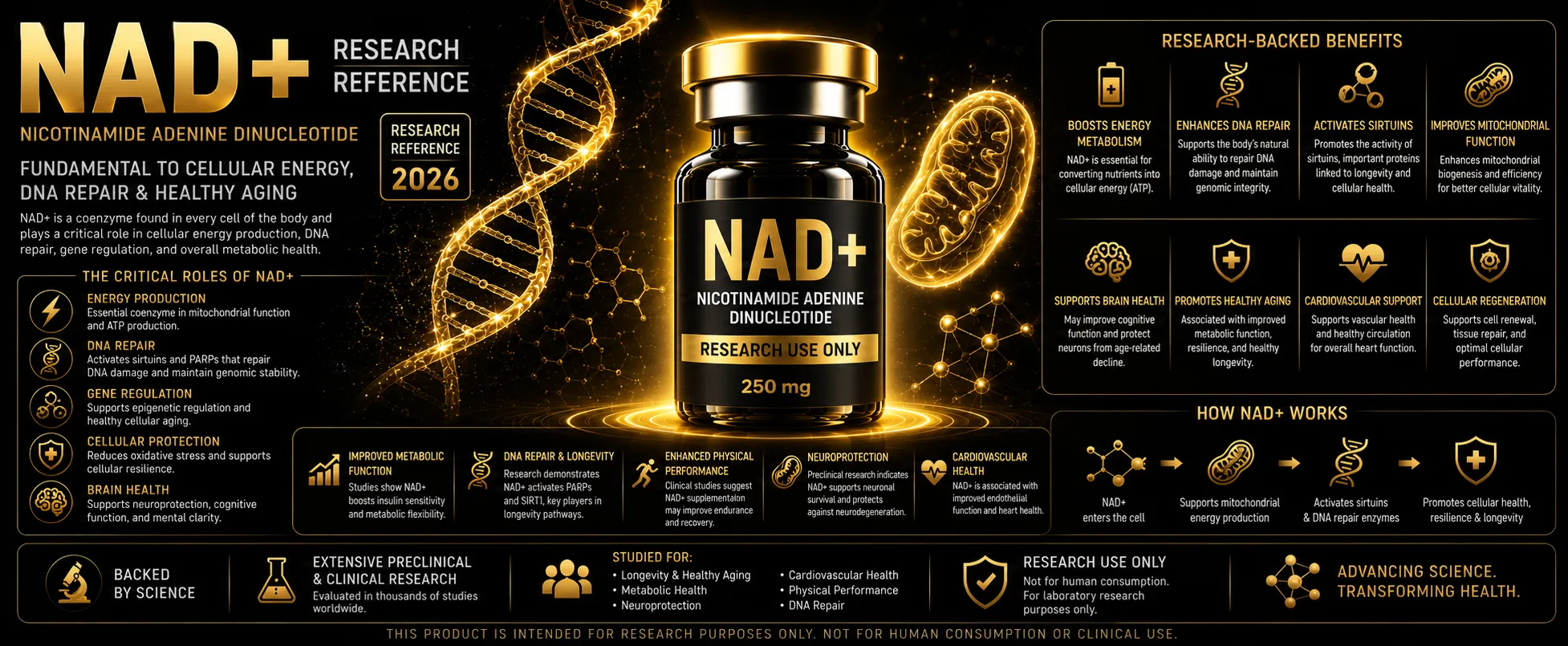
NAD+ UK: Research Reference 2026
This reference is strictly for laboratory and in vitro research purposes. Not for human or animal consumption. Not a medicine, food, cosmetic, or dietary supplement. Not approved by the MHRA.
Overview
NAD+ (nicotinamide adenine dinucleotide) is a coenzyme found in all living cells. It is a dinucleotide composed of two nucleotides joined by their phosphate groups: one nucleotide contains an adenine base, and the other contains nicotinamide. NAD+ is central to metabolism, serving as an essential electron carrier in redox reactions and as a substrate for several classes of enzymes involved in cellular signalling and DNA repair.
The molecule exists in two forms: NAD+ (oxidised) and NADH (reduced). The NAD+/NADH ratio is a critical indicator of cellular metabolic state, with high NAD+ levels associated with active metabolism and high NADH levels associated with reduced metabolic activity. NAD+ levels decline with age, falling by approximately 50% between age 20 and age 60 in human tissues.
For UK research laboratories, NAD+ serves as a reference compound for studies examining cellular metabolism, redox biology, and the role of NAD+-dependent enzymes in ageing and metabolic regulation. The coenzyme is supplied in lyophilised form for maximum stability and is reconstituted immediately before use in assays.
Molecular Structure
NAD+ is a dinucleotide with the following structural characteristics:
- Formula: C21H27N7O14P2
- Molecular weight: 663.4 Da (oxidised form)
- Structure: Adenine + ribose + pyrophosphate + nicotinamide + ribose
- Redox centre: Nicotinamide ring (accepts/donates hydride ion, H−)
- Charge: Net negative charge at physiological pH due to phosphate groups
The molecule consists of two nucleotides—adenosine monophosphate (AMP) and nicotinamide monophosphate (NMN)—joined by a pyrophosphate linkage. The nicotinamide moiety contains a positively charged pyridinium ring that is the site of redox chemistry. Upon reduction, NAD+ accepts a hydride ion (two electrons and one proton) at the C4 position of the nicotinamide ring, forming NADH.
Mechanism of Action
NAD+ operates through several distinct mechanisms in cellular and in vitro models:
Redox Metabolism
NAD+ serves as an electron carrier in metabolic reactions. In glycolysis, the citric acid cycle, and fatty acid oxidation, NAD+ accepts electrons from substrates, becoming NADH. The NADH then donates electrons to the electron transport chain, driving ATP synthesis. The NAD+/NADH ratio regulates metabolic flux and cellular energy status.
Sirtuin Activation
NAD+ is the essential substrate for sirtuins (SIRT1–SIRT7), a family of NAD+-dependent deacetylases. Sirtuins regulate gene expression, metabolic pathways, and cellular stress responses by removing acetyl groups from histones and other proteins. In cellular models, NAD+ availability directly determines sirtuin activity, linking metabolic state to epigenetic regulation.
PARP Activity
NAD+ is consumed by poly(ADP-ribose) polymerases (PARPs), enzymes that detect DNA damage and initiate repair. PARP1, the most abundant PARP, consumes NAD+ to synthesise poly(ADP-ribose) chains on target proteins, recruiting DNA repair machinery. In cellular studies, excessive DNA damage can deplete NAD+ through PARP overactivation.
CD38 and NAD+ Degradation
CD38 is a membrane-bound NADase that degrades NAD+ to cyclic ADP-ribose (cADPR) and nicotinamide. CD38 expression increases with age, contributing to NAD+ decline. In cellular models, CD38 inhibition preserves NAD+ levels and maintains sirtuin activity.
NAD+ Salvage Pathway
Cells regenerate NAD+ through the salvage pathway, converting nicotinamide to NMN via nicotinamide phosphoribosyltransferase (NAMPT), then to NAD+ via NMN adenylyltransferase (NMNAT). In cellular studies, NAMPT expression and activity determine the rate of NAD+ resynthesis.
Research Applications
NAD+ is employed across multiple research domains in UK laboratories:
Metabolic Research
In vitro studies examine NAD+ as a cofactor in glycolytic, citric acid cycle, and oxidative phosphorylation assays. Researchers use NAD+ to study metabolic flux, electron transport chain activity, and ATP production in cellular models. The NAD+/NADH ratio is measured as an indicator of metabolic state.
Ageing and Cellular Senescence
Cellular senescence models examine NAD+ decline as a marker of ageing. Researchers study the effects of NAD+ depletion on sirtuin activity, mitochondrial function, and DNA repair capacity. The relationship between NAD+ levels and cellular senescence markers (p16, p21, SA-β-gal) is quantified in ageing models.
DNA Repair and Genotoxic Stress
Cellular models of genotoxic stress examine NAD+ consumption by PARPs during DNA damage response. Researchers study whether NAD+ supplementation supports DNA repair capacity, reduces chromosomal aberrations, and maintains genomic stability in stressed cells.
Mitochondrial Function
NAD+ is essential for mitochondrial bioenergetics. In cellular models, NAD+ levels are correlated with mitochondrial membrane potential, ATP synthesis rate, and reactive oxygen species production. Researchers examine whether NAD+ availability supports mitochondrial biogenesis and function.
Sirtuin Pharmacology
NAD+ is used as a cofactor in sirtuin activity assays. Researchers compare NAD+ concentrations, sirtuin substrate specificity, and the effects of NAD+ modulators on deacetylase activity in cellular extracts.
Cellular and In Vitro Models
UK research laboratories employ several standard cellular models for NAD+ studies:
NAD+/NADH Ratio Assays
Cellular lysates are assayed for NAD+ and NADH content using enzymatic cycling assays or fluorescent probes. The NAD+/NADH ratio is calculated as a metabolic indicator. NAD+ is added to cell culture media or directly to lysates depending on the assay format.
Sirtuin Activity Assays
Cellular extracts or recombinant sirtuins are incubated with NAD+ and acetylated substrate peptides. Deacetylation is measured by fluorescence or luminescence. NAD+ concentration is varied to determine Km and Vmax parameters for different sirtuin isoforms.
PARP Activity Assays
Cellular extracts or recombinant PARP1 are incubated with NAD+ and DNA substrates. Poly(ADP-ribose) synthesis is measured by antibody detection or radioactive labelling. NAD+ consumption is quantified as a function of DNA damage signal.
Mitochondrial Respiration
Seahorse respirometry and isolated mitochondria assays measure oxygen consumption rate in response to NAD+ availability. NAD+ is added to media or mitochondrial suspensions to examine effects on Complex I activity and electron transport chain function.
Cellular NAD+ Depletion Models
Cells are treated with NAD+ depleting agents (FK866, a NAMPT inhibitor) to model age-related NAD+ decline. The effects of NAD+ supplementation on cellular function, gene expression, and stress resistance are examined.
Safety Profile in Preclinical Research
NAD+ safety profile is based on cellular and biochemical studies. As a natural coenzyme present in all cells, NAD+ has low inherent toxicity. In vitro studies have not identified cytotoxicity at physiological and supraphysiological concentrations.
In cellular models, excessive NAD+ supplementation may alter the NAD+/NADH ratio and metabolic flux, though cells regulate NAD+ uptake and utilisation through feedback mechanisms. The primary consideration is maintaining the oxidised/reduced ratio appropriate for the specific assay.
NAD+ is light-sensitive and degrades in solution over time. Freshly prepared solutions are recommended for cellular assays. The coenzyme is generally stable as a lyophilised powder under proper storage conditions.
Standard laboratory precautions apply: NAD+ is a research biochemical, not a medicine or dietary supplement. It is supplied for in vitro and laboratory research only.
Reconstitution and Handling
NAD+ is supplied as a lyophilised powder in research-grade vials. Standard laboratory preparation:
- Reconstitution: Sterile water or phosphate-buffered saline (PBS) is recommended for laboratory preparations
- Concentration: Typical stock concentrations range from 10–100 mM depending on assay requirements
- Storage: Lyophilised powder at −20 °C, protected from light; reconstituted solution at 2–8 °C, use within 24 hours
- Stability: NAD+ is unstable in solution; prepare fresh for each assay and avoid storage of reconstituted solutions
- Solubility: Freely soluble in aqueous solutions; gentle vortexing may aid dissolution
- Light sensitivity: Protect from light during storage and use; degradation products include NADH and nicotinamide
- pH: Optimal stability at pH 7.0–8.0; avoid acidic or strongly alkaline conditions
The lyophilised powder is hygroscopic; store in a desiccated environment. Reconstituted solutions may turn yellow if contaminated with NADH; discard if colour change is observed. Use glass or high-quality polypropylene containers to minimise adsorption.
UK Research Status
NAD+ is not a controlled substance under the UK Misuse of Drugs Act 1971 and is not scheduled under the Psychoactive Substances Act 2016. It is classified as a research biochemical for laboratory use and is not licensed as a medicine by the MHRA.
For UK research laboratories, NAD+ is available as a research-grade reference material. Sourcing should include:
- Certificate of Analysis confirming ≥99% purity (HPLC)
- Mass spectrometry or NMR identity confirmation (molecular weight 663.4 Da)
- Confirmation of oxidised form (NAD+), not reduced form (NADH)
- Batch-specific testing documentation
- Appropriate storage and shipping conditions (cold chain, protected from light)
- Research-use-only labelling
Researchers should ensure compliance with institutional ethics approvals for animal studies, and adhere to standard laboratory safety protocols for biochemical handling.
Frequently Asked Questions
References
- [1] Imai S, Guarente L. NAD+ and sirtuins in aging and disease. Trends Cell Biol 2014;24:464-471.
- [2] Bogan KL, Brenner C. Nicotinic acid, nicotinamide, and nicotinamide riboside: a molecular evaluation of NAD+ precursor vitamins in human nutrition. Annu Rev Nutr 2008;28:115-130.
- [3] Yoshino J, Baur JA, Imai SI. NAD+ intermediates: the biology and therapeutic potential of NMN and NR. Cell Metab 2018;27:513-528.
- [4] Camacho-Pereira J et al. CD38 dictates age-related NAD decline and mitochondrial dysfunction through an SIRT3-dependent mechanism. Cell Metab 2016;23:1127-1139.
- [5] Houtkooper RH, Pirinen E, Auwerx J. Sirtuins as regulators of metabolism and healthspan. Nat Rev Mol Cell Biol 2012;13:225-238.
For laboratory and in vitro research use only. Not for human consumption. Not a medicine. Nothing in this article constitutes medical advice. UK researchers are responsible for compliance with the Human Medicines Regulations 2012 and Misuse of Drugs Regulations 2001 where applicable.