
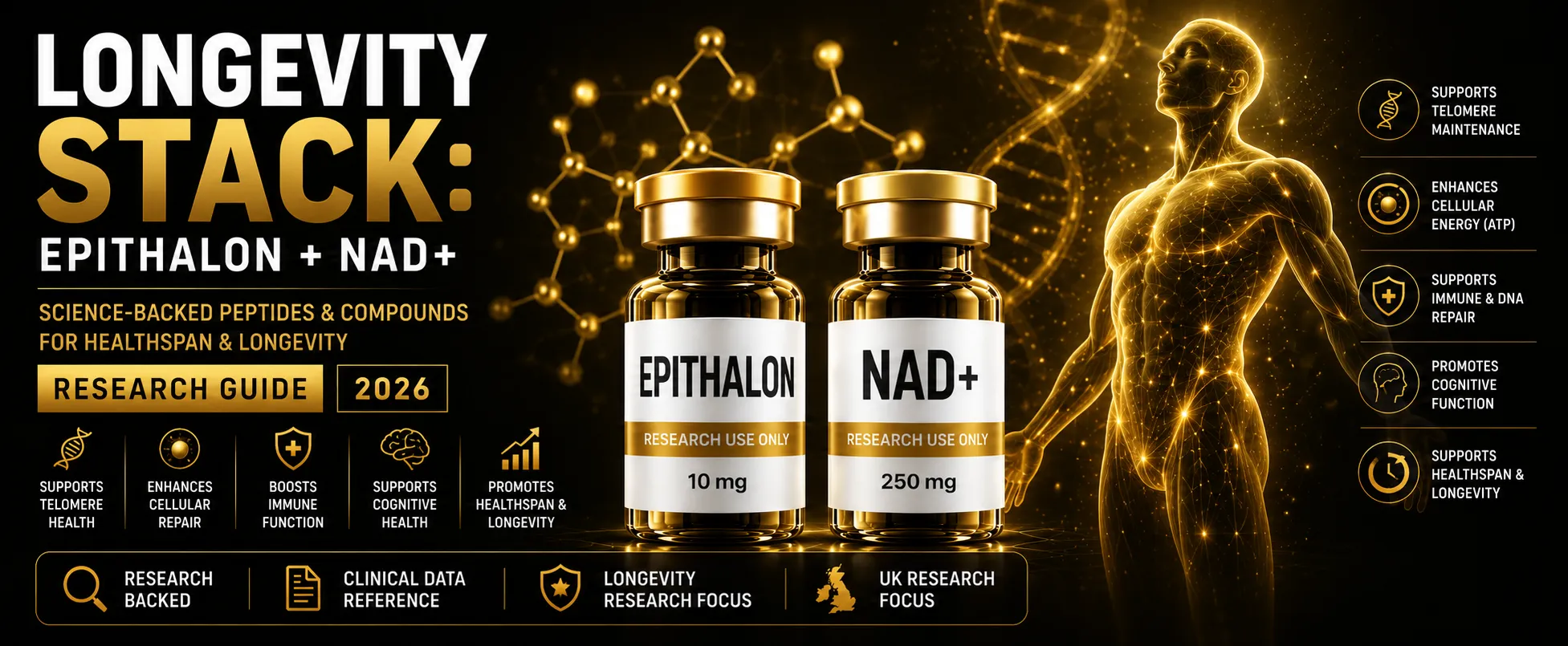
Longevity Stack: Epithalon + NAD+ Research Guide 2026
This reference is strictly for laboratory and in vitro research purposes. Not for human or animal consumption. Not a medicine, food, cosmetic, or dietary supplement. Not approved by the MHRA.
Overview
The Longevity Stack combines Epithalon, a synthetic tetrapeptide studied for telomerase activation and pineal axis regulation, with NAD+ (nicotinamide adenine dinucleotide), a coenzyme central to cellular metabolism, redox reactions, and sirtuin activation. This combination creates a dual-mechanism model for ageing research: Epithalon provides the telomere maintenance and cellular senescence layer, while NAD+ provides the metabolic and epigenetic regulation layer.
Epithalon (Ala-Glu-Asp-Gly) is a 4-amino-acid peptide originally isolated from the pineal gland. It is studied for its effects on telomerase activity, cellular replicative lifespan, and pineal hormone regulation. NAD+ is a dinucleotide found in all living cells, serving as an essential electron carrier and substrate for sirtuins, PARPs, and other enzymes involved in DNA repair and metabolic regulation.
For UK research laboratories, the Longevity Stack offers a comprehensive model for studying cellular ageing mechanisms. Epithalon's telomerase-mediated effects are studied alongside NAD+'s metabolic and epigenetic regulation to examine how telomere maintenance and cellular energy status interact in ageing models.
Molecular Structure
Epithalon
- Sequence: Ala-Glu-Asp-Gly (4 amino acids)
- Molecular weight: ~390.4 Da
- Origin: Synthetic version of a pineal gland peptide
- Size: One of the smallest bioactive peptides in research use
NAD+
- Formula: C21H27N7O14P2
- Molecular weight: 663.4 Da (oxidised form)
- Structure: Adenine + ribose + pyrophosphate + nicotinamide + ribose
- Redox centre: Nicotinamide ring (accepts/donates hydride ion)
Structural Differences
Epithalon is a small linear peptide with rapid cellular uptake and direct nuclear localisation. NAD+ is a dinucleotide with negatively charged phosphate groups and a bulky adenine-nicotinamide structure. The size and chemical class differences reflect their distinct mechanisms: Epithalon acts as a peptide signalling molecule for telomerase regulation, while NAD+ acts as a metabolic cofactor and enzyme substrate.
Mechanism of Action
Epithalon Mechanisms
Epithalon operates through several pathways in cellular and in vitro models:
- Telomerase activation: Upregulates telomerase expression and activity, particularly in fibroblast and epithelial cell cultures
- Pineal axis regulation: Modulates melatonin synthesis enzymes and circadian rhythm gene expression
- Cellular senescence: Examined for effects on senescence markers (p16, p21, SA-β-galactosidase) and replicative lifespan
- DNA repair: Studied for effects on DNA repair capacity and chromosomal stability
- Gene expression modulation: Modulates cell cycle, apoptosis, and stress resistance genes
NAD+ Mechanisms
NAD+ operates through multiple distinct pathways:
- Redox metabolism: Serves as electron carrier in glycolysis, citric acid cycle, and oxidative phosphorylation
- Sirtuin activation: Essential substrate for SIRT1–SIRT7, linking metabolic state to epigenetic regulation
- PARP activity: Consumed by PARPs during DNA damage response and repair
- CD38 regulation: NAD+ levels decline with age due to increased CD38 expression
- Salvage pathway: Regenerated from nicotinamide via NAMPT and NMNAT enzymes
Complementary Mechanism
In combined research models, Epithalon provides the telomere maintenance and replicative lifespan extension signals, while NAD+ provides the metabolic and epigenetic machinery required for cellular health. The combination enables researchers to study how telomere integrity interacts with metabolic status, sirtuin activity, and DNA repair capacity in ageing cells. Telomerase-mediated telomere maintenance may require sufficient NAD+ for the metabolic energy and sirtuin activity needed to support cellular replication.
Research Applications
The Longevity Stack is employed across multiple research domains in UK laboratories:
Telomere Maintenance Research
Cellular models examine the combined effects on telomerase activity, telomere length, and replicative lifespan. Researchers use fibroblast and epithelial cell cultures to study whether Epithalon's telomerase activation and NAD+'s metabolic support produce coordinated effects on telomere maintenance.
Cellular Senescence Studies
Senescence models examine the stack's effects on senescence markers, including p16, p21, SA-β-galactosidase, and telomere dysfunction-induced foci. The combination of telomerase activation and NAD+-dependent sirtuin activity creates a dual anti-senescence model.
Mitochondrial Function in Ageing
Cellular models examine the combined effects on mitochondrial respiration, ATP production, and reactive oxygen species generation. NAD+ is essential for mitochondrial bioenergetics, while Epithalon's effects on cellular replicative capacity may influence mitochondrial biogenesis and function.
DNA Repair and Genomic Stability
Cells exposed to genotoxic stress are treated with the stack to examine combined effects on DNA repair capacity, chromosomal aberrations, and genomic integrity. NAD+ supports PARP-mediated DNA repair, while Epithalon may influence DNA repair enzyme expression.
Comparative Longevity Studies
The stack is compared to single treatments and other longevity compounds (resveratrol, sirtuin activators, NAD+ precursors) in cellular studies. Research questions examine whether telomerase-mediated and metabolic approaches produce additive effects on cellular lifespan and healthspan markers.
Cellular and In Vitro Models
UK research laboratories employ several standard cellular models for Longevity Stack studies:
Fibroblast Lifespan Studies
Primary human fibroblasts are serially passaged with the stack treatment, and population doublings are counted. Senescence markers (SA-β-gal, p16, p21) are measured at each passage. Telomere length is monitored by Southern blot or qPCR. The combination is compared to Epithalon alone, NAD+ alone, and vehicle controls.
Telomerase Activity Assays
Cellular extracts are incubated with Epithalon, and telomerase activity is measured by TRAP assay. NAD+ is added to examine whether metabolic cofactor availability influences telomerase activity. Endpoints include telomerase expression (qPCR, Western blot) and telomere length.
NAD+/NADH Ratio Assays
Cellular lysates are assayed for NAD+ and NADH content using enzymatic cycling assays or fluorescent probes. The NAD+/NADH ratio is calculated as a metabolic indicator. Epithalon is added to examine whether telomerase activation influences cellular metabolic state.
Sirtuin Activity Assays
Cellular extracts or recombinant sirtuins are incubated with NAD+ and acetylated substrate peptides. Deacetylation is measured by fluorescence or luminescence. Epithalon is added to examine whether telomerase-mediated cellular changes influence sirtuin activity or substrate specificity.
DNA Repair Assays
Cells are exposed to UV radiation or hydrogen peroxide, then treated with the stack to examine combined effects on DNA repair capacity. Endpoints include comet assay, γ-H2AX foci, and chromosomal aberration frequency.
Safety and Sourcing Standards
Both compounds in the Longevity Stack require high-purity research-grade materials for valid experimental results.
Epithalon Sourcing Requirements
- ≥98% purity (HPLC), ≥99% preferred
- Mass spectrometry confirming 4-amino-acid sequence (Ala-Glu-Asp-Gly)
- Molecular weight verification (~390.4 Da)
- Batch-specific COA with endotoxin levels
- Research-use-only labelling
NAD+ Sourcing Requirements
- ≥99% purity (HPLC)
- Mass spectrometry or NMR identity confirmation (molecular weight 663.4 Da)
- Confirmation of oxidised form (NAD+), not reduced form (NADH)
- Batch-specific COA with endotoxin levels
- Research-use-only labelling
Safety Profile
Both compounds have favourable safety profiles in preclinical cellular and animal studies. In vitro toxicology screens have not identified significant cytotoxicity at research-relevant concentrations. No organ-specific toxicity has been reported at standard research doses.
UK Legal Status
Both compounds are not controlled substances under the Misuse of Drugs Act 1971 and are not scheduled under the Psychoactive Substances Act 2016. They are classified as research biochemicals and are not licensed as medicines by the MHRA.
Frequently Asked Questions
References
- [1] Khavinson VKh et al. Epithalon peptide induces telomerase activity and telomere elongation in human somatic cells. Bull Exp Biol Med 2003;135:590-592.
- [2] Imai S, Guarente L. NAD+ and sirtuins in aging and disease. Trends Cell Biol 2014;24:464-471.
- [3] Anisimov VN et al. Effects of epitalon on biomarkers of aging, life span and spontaneous tumor incidence in female Swiss-derived SHR mice. Biogerontology 2003;4:193-202.
- [4] Yoshino J, Baur JA, Imai SI. NAD+ intermediates: the biology and therapeutic potential of NMN and NR. Cell Metab 2018;27:513-528.
- [5] Khavinson VKh et al. The effects of short peptides on gene expression. Bull Exp Biol Med 2009;147:248-251.
For laboratory and in vitro research use only. Not for human consumption. Not a medicine. Nothing in this article constitutes medical advice. UK researchers are responsible for compliance with the Human Medicines Regulations 2012 and Misuse of Drugs Regulations 2001 where applicable.