
BPC-157 vs TB-500: UK Regenerative Research Comparison 2026
This reference is strictly for laboratory and in vitro research purposes. Not for human or animal consumption. Not a medicine, food, cosmetic, or dietary supplement. Not approved by the MHRA.
Overview
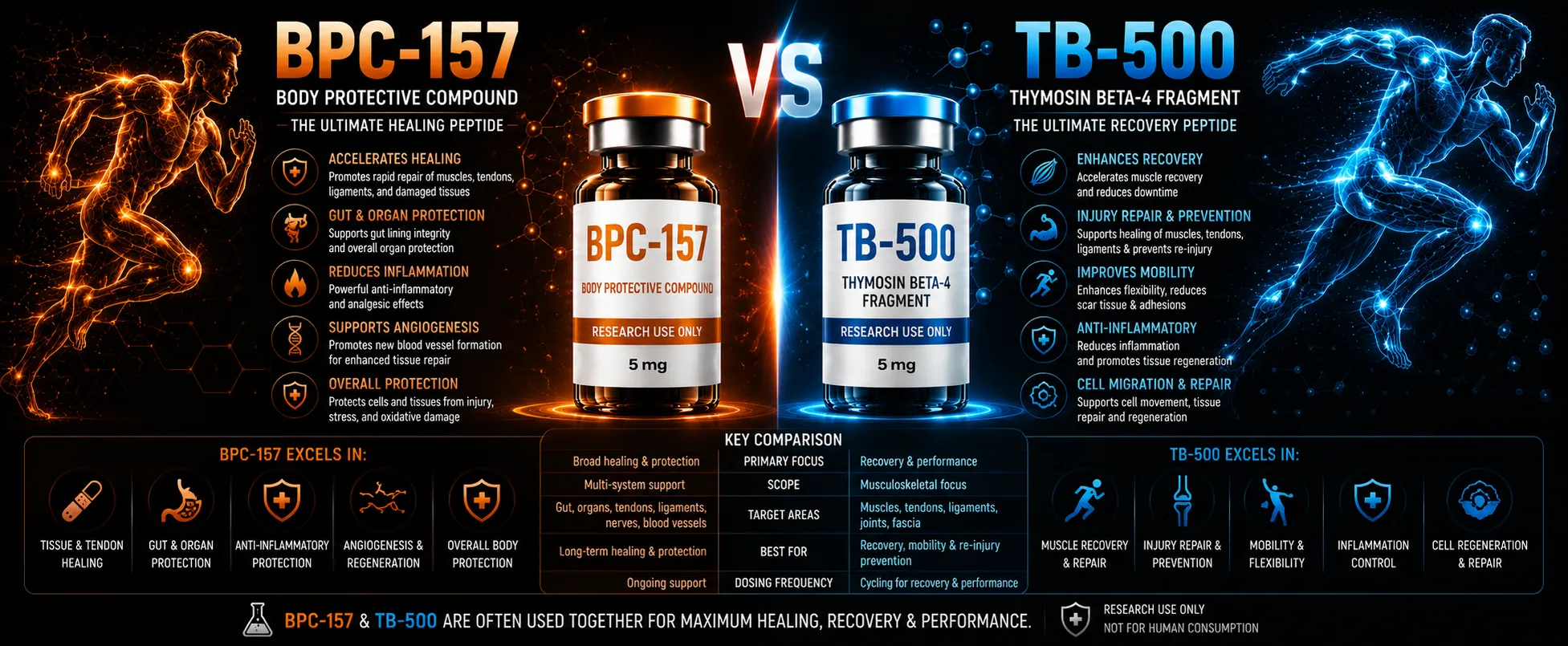
BPC-157 and TB-500 are both synthetic peptides studied in regenerative research, but they differ in origin, mechanism, and primary research applications. BPC-157 is a 15-amino-acid pentadecapeptide derived from a gastric protein, while TB-500 is a 43-amino-acid peptide representing the synthetic version of Thymosin Beta-4.
For UK research laboratories, the choice between these peptides depends on the research model: BPC-157 is frequently studied for angiogenesis, fibroblast activation, and gastrointestinal protection, while TB-500 is primarily studied for actin regulation, cellular migration, and wound healing.
This comparison covers molecular structure, mechanism of action, research applications, cellular models, and sourcing standards for both compounds.
Molecular Structure Comparison
BPC-157
- Sequence: Gly-Glu-Pro-Pro-Pro-Gly-Lys-Pro-Ala-Asp-Asp-Ala-Gly-Leu-Val (15 amino acids)
- Molecular weight: ~1,419 Da
- Origin: Synthetic partial sequence of human gastric Body Protection Compound
- Structure: Linear peptide with multiple proline residues conferring rigidity
TB-500
- Sequence: 43 amino acids with N-terminal acetylated SDKP sequence
- Molecular weight: ~4,963 Da
- Origin: Synthetic version of endogenous Thymosin Beta-4
- Structure: Acetylated N-terminus with central actin-binding domain
Structural Differences
BPC-157 is significantly smaller than TB-500 (15 vs 43 amino acids) and lacks post-translational modifications. TB-500 contains an N-terminal acetylation and an actin-binding domain (residues 17–23) that is critical for its biological activity. The size difference influences cellular penetration, receptor interactions, and proteolytic susceptibility in research models.
Mechanism of Action Comparison
BPC-157: Multi-Pathway Regenerative Mechanism
BPC-157 operates through several distinct mechanisms:
- Angiogenesis: Upregulates VEGF and stimulates endothelial cell proliferation and migration
- Fibroblast activation: Increases collagen synthesis and extracellular matrix deposition
- Gastrointestinal protection: Maintains epithelial integrity and tight junction function
- Anti-inflammatory signalling: Modulates NF-κB and reduces pro-inflammatory cytokines
- Nitric oxide pathway: Enhances eNOS expression and NO production
TB-500: Actin-Regulation Mechanism
TB-500 primarily regulates the cytoskeleton:
- Actin sequestration: Binds G-actin, preventing polymerisation into F-actin
- Cellular migration: Promotes lamellipodia formation and directional cell movement
- Angiogenesis: Stimulates endothelial cell migration and tube formation
- Anti-inflammatory effects: N-terminal SDKP sequence reduces pro-inflammatory signalling
- Tissue regeneration: Supports repair through enhanced cell migration and reduced inflammation
Key Research Differences
- BPC-157 produces multi-pathway regenerative effects with emphasis on angiogenesis and fibroblast activation
- TB-500 primarily regulates actin dynamics and cell motility, with secondary angiogenic effects
- BPC-157's gastric origin makes it relevant for gastrointestinal research
- TB-500's actin regulation is central to wound healing and tissue repair models
Research Applications Comparison
BPC-157 Research Applications
- Wound healing and angiogenesis studies
- Tendon, ligament, and connective tissue repair
- Gastrointestinal epithelial integrity and mucosal protection
- Anti-inflammatory and NF-κB modulation research
- Vascular regeneration and endothelial function
TB-500 Research Applications
- Wound healing and cellular migration studies
- Musculoskeletal and cardiac tissue repair
- Ocular and corneal epithelial healing
- Actin cytoskeleton and cell motility research
- Vascular repair and endothelial tube formation
When to Choose BPC-157
- Research questions involve angiogenesis and fibroblast activation
- Studying gastrointestinal protective mechanisms
- Examining multi-pathway tissue regeneration
- Researching anti-inflammatory effects in wound healing
When to Choose TB-500
- Research questions involve actin regulation and cell migration
- Studying wound healing through cytoskeletal remodelling
- Examining endothelial cell motility and tube formation
- Researching tissue repair in cardiac, ocular, or musculoskeletal models
Cellular Models Comparison
BPC-157 Cellular Models
- Fibroblast scratch assays for wound closure and collagen deposition
- HUVEC tube formation assays for angiogenesis
- Ex vivo tendon and ligament explants for connective tissue repair
- Caco-2 epithelial cells for barrier integrity and tight junctions
- RAW 264.7 macrophages for inflammation and cytokine modulation
TB-500 Cellular Models
- Fibroblast scratch assays with time-lapse microscopy for migration dynamics
- HUVEC Matrigel assays for tube formation and network complexity
- Corneal epithelial cells for ocular wound healing
- Primary cardiomyocytes for cardiac cell survival and migration
- Fluorescent phalloidin staining for F-actin organisation
Comparative Experimental Design
Researchers often use both peptides in parallel to compare:
- Wound closure rate (BPC-157's fibroblast activation vs TB-500's actin-regulated migration)
- Angiogenic response (BPC-157's VEGF upregulation vs TB-500's endothelial motility)
- Collagen synthesis (BPC-157's direct stimulation vs TB-500's indirect matrix remodelling)
- Anti-inflammatory effects (BPC-157's NF-κB modulation vs TB-500's cytokine reduction)
UK Sourcing and Purity Standards
Both BPC-157 and TB-500 require high-purity research-grade materials for valid experimental results.
BPC-157 Sourcing Requirements
- ≥98% purity (HPLC), ≥99% preferred
- Mass spectrometry confirming 15-amino-acid sequence
- Molecular weight verification (~1,419 Da)
- Batch-specific COA with endotoxin levels
- Research-use-only labelling
TB-500 Sourcing Requirements
- ≥98% purity (HPLC), ≥99% preferred
- Mass spectrometry confirming 43-amino-acid sequence and N-terminal acetylation
- Molecular weight verification (~4,963 Da)
- Batch-specific COA with endotoxin levels
- Research-use-only labelling
UK Legal Status
Both peptides are not controlled substances under the Misuse of Drugs Act 1971 and are not scheduled under the Psychoactive Substances Act 2016. They are classified as research peptides and are not licensed as medicines by the MHRA.
Frequently Asked Questions
References
- [1] Sikiric P et al. Stable gastric pentadecapeptide BPC 157: multiple organoprotection and therapeutic possibilities. Curr Pharm Des 2020;26:3947-3957.
- [2] Goldstein AL et al. Thymosin beta4: a multi-functional regenerative peptide. Expert Opin Biol Ther 2012;12:37-51.
- [3] Sikiric P et al. BPC 157 and its effects on healing. Life Sci 2020;259:118198.
- [4] Malinda KM et al. Thymosin beta4 accelerates wound healing. J Invest Dermatol 1999;113:364-368.
- [5] Gwyer D et al. The stable gastric pentadecapeptide BPC 157: an overview of the current status. Curr Pharm Des 2020;26:3967-3978.
For laboratory and in vitro research use only. Not for human consumption. Not a medicine. Nothing in this article constitutes medical advice. UK researchers are responsible for compliance with the Human Medicines Regulations 2012 and Misuse of Drugs Regulations 2001 where applicable.