
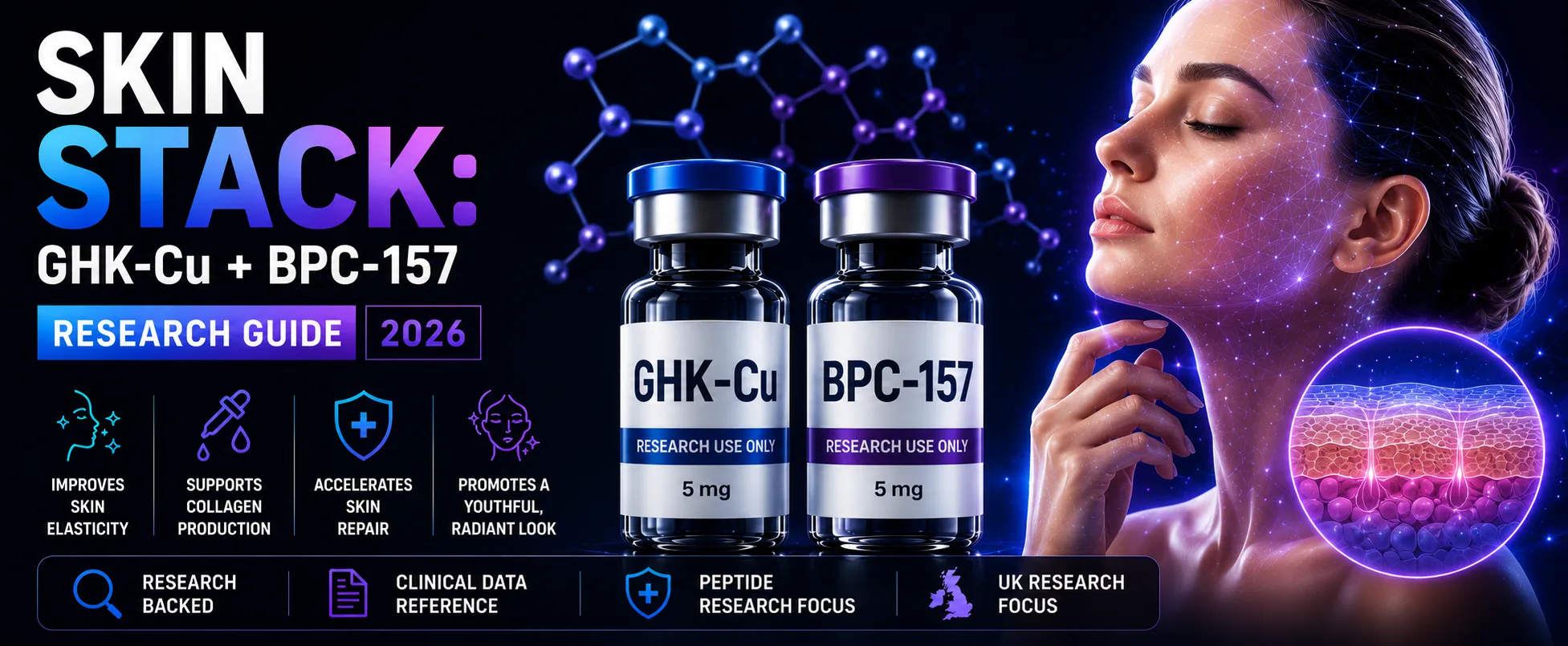
Skin Stack: GHK-Cu + BPC-157 Research Guide 2026
This reference is strictly for laboratory and in vitro research purposes. Not for human or animal consumption. Not a medicine, food, cosmetic, or dietary supplement. Not approved by the MHRA.
Overview
The Skin Stack combines GHK-Cu (glycyl-L-histidyl-L-lysine copper), a copper-binding tripeptide studied for collagen synthesis and extracellular matrix remodelling, with BPC-157 (Body Protection Compound-157), a 15-amino-acid pentadecapeptide studied for angiogenesis, fibroblast activation, and wound healing. This combination creates a dual-mechanism model for dermal and tissue repair research: GHK-Cu provides the matrix-building and copper-delivery signals, while BPC-157 provides the angiogenic and fibroblast-activating signals.
GHK-Cu occurs naturally in human plasma and declines with age from approximately 200 ng/mL at age 20 to about 80 ng/mL at age 60. The peptide binds copper ions and delivers them to copper-dependent enzymes involved in collagen cross-linking, antioxidant defence, and angiogenesis. BPC-157 is derived from a partial sequence of the human gastric protein BPC and retains the bioactive domain of the parent protein.
For UK research laboratories, the Skin Stack offers a comprehensive model for studying dermal regeneration, wound healing, and extracellular matrix remodelling. GHK-Cu's copper delivery and gene expression modulation complement BPC-157's angiogenic and fibroblast-activating properties in skin and tissue repair models.
Molecular Structure
GHK-Cu
- Sequence: Glycyl-L-histidyl-L-lysine (3 amino acids)
- Molecular weight (free peptide): ~340 Da
- Molecular weight (copper complex): ~400 Da
- Copper binding: High affinity (2:1 peptide:copper ratio)
- Coordination: Copper binds to nitrogen atoms from glycine α-amine, histidine imidazole, and lysine ε-amine
BPC-157
- Sequence: Gly-Glu-Pro-Pro-Pro-Gly-Lys-Pro-Ala-Asp-Asp-Ala-Gly-Leu-Val (15 amino acids)
- Molecular weight: ~1,419 Da
- Structure: Linear pentadecapeptide with multiple proline residues
- Origin: Synthetic partial sequence of human gastric Body Protection Compound
Structural Differences
GHK-Cu is a tripeptide-copper complex with a characteristic blue-violet colour when reconstituted. BPC-157 is a larger linear peptide without metal coordination. The copper component of GHK-Cu is essential for its biological activity, while BPC-157's activity is peptide-sequence dependent. Both are supplied as lyophilised powders, though GHK-Cu is typically supplied as the pre-formed copper complex.
Mechanism of Action
GHK-Cu Mechanisms
GHK-Cu operates through several pathways in cellular and in vitro models:
- Copper delivery: Delivers copper to copper-dependent enzymes (lysyl oxidase, superoxide dismutase, tyrosinase)
- Gene expression modulation: Modulates approximately 4,000 genes involved in tissue remodelling, antioxidant defence, and anti-inflammatory pathways
- Collagen synthesis: Stimulates fibroblast production of collagen types I, III, and IV
- Wound healing: Promotes fibroblast migration, angiogenesis, and extracellular matrix deposition
- Anti-inflammatory effects: Modulates TGF-β signalling and reduces inflammatory cytokine production
BPC-157 Mechanisms
BPC-157 operates through multiple regenerative pathways:
- Angiogenesis: Upregulates VEGF and stimulates endothelial cell proliferation and migration
- Fibroblast activation: Increases collagen synthesis and extracellular matrix deposition
- Nitric oxide pathway: Enhances eNOS expression and NO production
- Anti-inflammatory signalling: Modulates NF-κB and reduces pro-inflammatory cytokines
- Tissue regeneration: Supports repair through enhanced cell migration and matrix production
Complementary Mechanism
In combined research models, GHK-Cu provides the copper-dependent enzymatic activity and gene expression changes required for matrix remodelling, while BPC-157 provides the vascular and fibroblast-activating signals required for tissue repair. The copper delivery from GHK-Cu supports lysyl oxidase-mediated collagen cross-linking, while BPC-157's angiogenesis creates the vascular infrastructure needed for tissue perfusion. The combination enables researchers to study how matrix-building and vascular signals interact in dermal regeneration models.
Research Applications
The Skin Stack is employed across multiple research domains in UK laboratories:
Dermal Repair Research
In vitro studies examine the combined effects on dermal fibroblast function, collagen synthesis, and extracellular matrix production. Researchers use fibroblast cultures, organotypic skin models, and tissue explants to study whether the dual-mechanism approach produces enhanced dermal repair compared to single-peptide models.
Wound Healing Studies
Scratch assays, organotypic cultures, and tissue explants are used to examine combined effects on wound closure, cellular migration, and tissue regeneration. GHK-Cu's fibroblast migration and collagen synthesis complement BPC-157's angiogenesis and fibroblast activation in wound healing models.
Collagen Synthesis Research
Fibroblast cultures are used to measure combined effects on collagen production, cross-linking, and extracellular matrix organisation. GHK-Cu's copper delivery supports lysyl oxidase activity, while BPC-157's fibroblast activation increases collagen gene expression and secretion.
Angiogenesis in Skin Models
Endothelial cell models and skin microvascular cultures examine the combined angiogenic effects of both peptides. BPC-157's VEGF upregulation and GHK-Cu's endothelial cell effects create a dual-angiogenic signal for studying vascularisation in dermal repair.
Anti-Inflammatory Dermal Research
Keratinocyte and fibroblast co-cultures examine combined anti-inflammatory effects in skin inflammation models. GHK-Cu's TGF-β modulation and BPC-157's NF-κB inhibition create a dual anti-inflammatory signal for studying chronic skin inflammation and repair.
Cellular and In Vitro Models
UK research laboratories employ several standard cellular models for Skin Stack studies:
Dermal Fibroblast Cultures
Primary dermal fibroblasts are used to measure combined effects on collagen I/III production, elastin synthesis, and extracellular matrix deposition. Endpoints include hydroxyproline assays, collagen ELISAs, and Sirius Red staining. The stack is compared to GHK-Cu alone, BPC-157 alone, and vehicle controls.
Fibroblast Scratch Assays
Scratch wound assays measure combined effects on migration, proliferation, and wound closure rate. Time-lapse microscopy tracks cell migration dynamics. Endpoints include wound closure percentage, collagen deposition, and matrix metalloproteinase activity.
Endothelial Tube Formation
HUVEC and dermal microvascular endothelial cells are used in Matrigel assays to examine combined angiogenic effects. Endpoints include tube length, branch points, network complexity, and VEGF production. The dual treatment is compared to individual peptides.
Keratinocyte Cultures
Primary keratinocytes and HaCaT cells are used to examine combined effects on epithelial migration, proliferation, and barrier function. Endpoints include scratch closure, transepithelial electrical resistance, and tight junction protein expression.
Organotypic Skin Models
Reconstructed human epidermis and full-thickness skin models are used to examine tissue-level effects on dermal regeneration, wound healing, and matrix remodelling. The stack is applied topically or added to culture media, and histological endpoints are examined.
Safety and Sourcing Standards
Both peptides in the Skin Stack require high-purity research-grade materials for valid experimental results.
GHK-Cu Sourcing Requirements
- ≥98% purity (HPLC), ≥99% preferred
- Mass spectrometry confirming tripeptide sequence and copper complex formation
- Copper stoichiometry confirmation (2:1 peptide:copper ratio, molecular weight ~400 Da)
- Batch-specific COA with endotoxin levels
- Research-use-only labelling
BPC-157 Sourcing Requirements
- ≥98% purity (HPLC), ≥99% preferred
- Mass spectrometry confirming 15-amino-acid sequence
- Molecular weight verification (~1,419 Da)
- Batch-specific COA with endotoxin levels
- Research-use-only labelling
Safety Profile
Both peptides have favourable safety profiles in preclinical cellular and animal studies. In vitro toxicology screens have not identified significant cytotoxicity at research-relevant concentrations. No organ-specific toxicity has been reported at standard research doses.
UK Legal Status
Both peptides are not controlled substances under the Misuse of Drugs Act 1971 and are not scheduled under the Psychoactive Substances Act 2016. They are classified as research peptides and are not licensed as medicines by the MHRA.
Frequently Asked Questions
References
- [1] Pickart L, Margolina A. Regenerative and protective actions of the GHK-Cu peptide in the light of the new gene data. Int J Mol Sci 2018;19:1987.
- [2] Sikiric P et al. Stable gastric pentadecapeptide BPC 157: multiple organoprotection and therapeutic possibilities. Curr Pharm Des 2020;26:3947-3957.
- [3] Pickart L et al. GHK peptide as a natural modulator of multiple cellular pathways in skin regeneration. Biomed Res Int 2015;2015:648108.
- [4] Sikiric P et al. BPC 157 and its effects on healing. Life Sci 2020;259:118198.
- [5] Maquart FX et al. In vivo stimulation of connective tissue accumulation by the tripeptide-copper complex GHK-Cu. J Clin Invest 1993;92:2368-2376.
For laboratory and in vitro research use only. Not for human consumption. Not a medicine. Nothing in this article constitutes medical advice. UK researchers are responsible for compliance with the Human Medicines Regulations 2012 and Misuse of Drugs Regulations 2001 where applicable.