
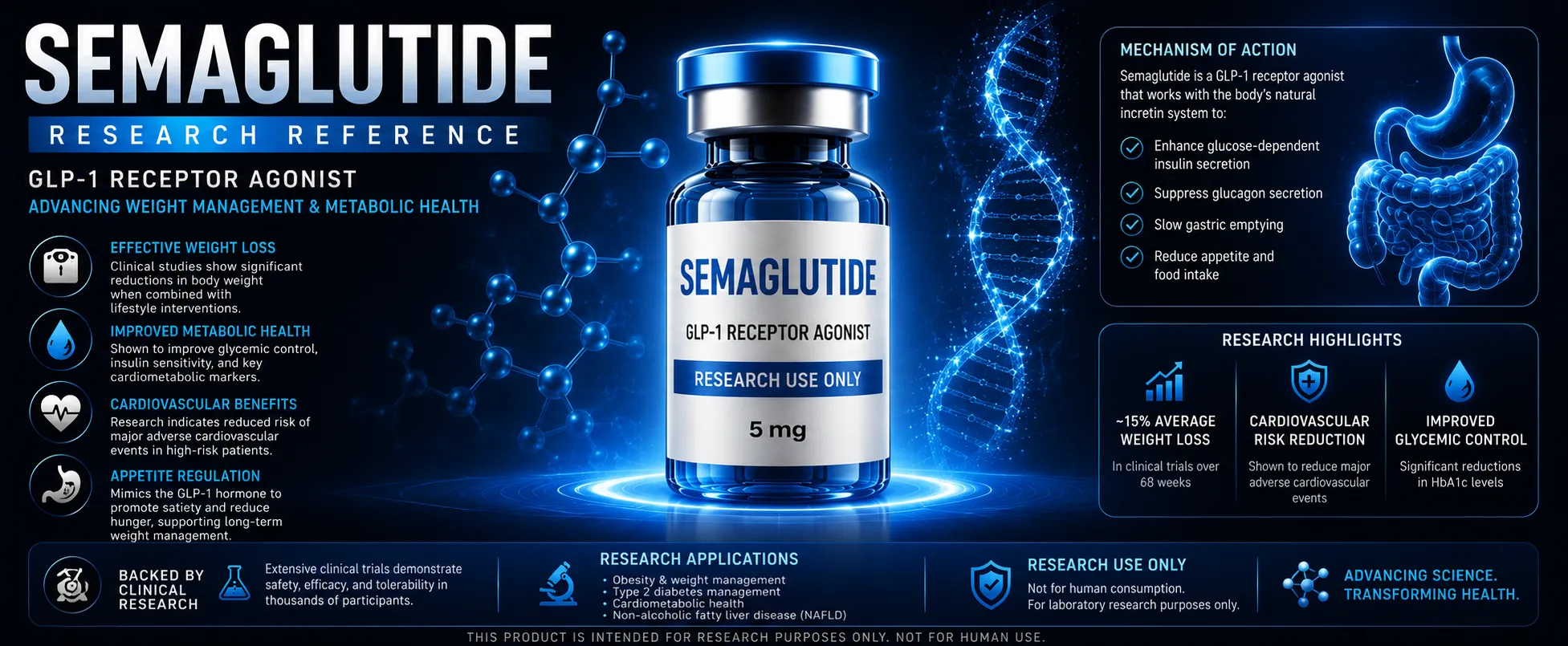
Semaglutide UK: Research Reference 2026
This reference is strictly for laboratory and in vitro research purposes. Not for human or animal consumption. Not a medicine, food, cosmetic, or dietary supplement. Not approved by the MHRA.
Overview
Semaglutide is a synthetic peptide analogue of human glucagon-like peptide-1 (GLP-1) with a modified amino acid sequence that confers resistance to dipeptidyl peptidase-4 (DPP-4) degradation and high affinity binding to serum albumin. The peptide is a 31-amino-acid sequence with a fatty-diacid side chain attached to a lysine residue at position 26, enabling prolonged half-life through albumin association.
The structural modifications include a single amino acid substitution at position 8 (alanine replaced by alpha-aminoisobutyric acid, Aib), which prevents DPP-4 cleavage and extends the peptide's biological activity. The C18 fatty-diacid chain at Lys26, linked via a gamma-glutamyl spacer and a polyethylene glycol (PEG) linker, facilitates non-covalent albumin binding, extending the plasma half-life to approximately 7 days in research models.
For UK research laboratories, semaglutide serves as a reference compound for studies examining GLP-1 receptor pharmacology, metabolic regulation, and the mechanisms of sustained incretin receptor activation in cellular and animal models.
Molecular Structure
Semaglutide is a 31-amino-acid peptide with the following structural characteristics:
- Sequence: 31 amino acids with N-terminal histidine and C-terminal glycine
- Molecular weight: Approximately 4,114 Da
- Modifications: Aib substitution at position 8 (DPP-4 resistance); C18 fatty-diacid chain at Lys26 via γ-Glu-2xAdo-PEG linker
- Albumin binding: The lipid chain facilitates non-covalent albumin association, extending plasma half-life to ~7 days
- C-terminus: Native amidation
The Aib substitution at position 8 is critical for DPP-4 resistance. DPP-4 cleaves native GLP-1 after Ala8, resulting in a 1.5-minute half-life. The Aib substitution prevents this cleavage, extending the half-life to hours. The fatty-diacid chain further extends the half-life to days through albumin binding, creating a once-weekly pharmacokinetic profile in research protocols.
Mechanism of Action
Semaglutide operates through the following mechanism in research models:
GLP-1 Receptor Agonism
Semaglutide binds to the GLP-1 receptor (GLP-1R), a class B GPCR expressed in pancreatic beta cells, gastric mucosa, and the central nervous system. Receptor activation increases intracellular cAMP, leading to protein kinase A activation, enhanced insulin gene transcription, and glucose-dependent insulin secretion. In cellular models, GLP-1R activation triggers delayed gastric emptying and central satiety signalling.
DPP-4 Resistance
The Aib8 substitution prevents cleavage by DPP-4, the enzyme that rapidly degrades native GLP-1. This structural modification allows semaglutide to maintain receptor occupancy for extended periods, enabling sustained signalling in cellular incubations and prolonged pharmacodynamic effects in animal models.
Albumin Binding and Half-Life Extension
The C18 fatty-diacid chain at Lys26 facilitates non-covalent binding to serum albumin. This albumin association acts as a circulating reservoir, slowly releasing free peptide for receptor engagement. The albumin-bound fraction protects the peptide from renal clearance and enzymatic degradation, creating a sustained exposure profile.
Metabolic Signalling
Through GLP-1R activation, semaglutide influences multiple metabolic pathways: enhanced glucose-dependent insulin secretion, suppression of glucagon release in hyperglycaemic states, delayed gastric emptying, and activation of brainstem satiety circuits. In cellular studies, these effects are quantified as insulin secretion rate, glucagon suppression, and neuronal activation patterns.
Research Applications
Semaglutide is employed across multiple research domains in UK laboratories:
Metabolic Disease Research
In vitro studies examine semaglutide's effects on insulin secretion, glucagon suppression, and glucose uptake in isolated islet and hepatocyte cultures. Researchers use the peptide to study sustained GLP-1 receptor activation, comparing the extended pharmacokinetic profile to short-acting GLP-1 analogues in terms of signalling amplitude and receptor desensitisation.
Appetite and Satiety Research
Cellular models of hypothalamic and brainstem neuronal cultures examine semaglutide's effects on appetite-regulating circuits. The peptide's central GLP-1R activation is studied in the context of satiety signalling, food intake regulation, and the neural mechanisms of energy balance.
Gastrointestinal Motility
In vitro studies of gastric smooth muscle and intestinal epithelial cells examine semaglutide's effects on motility, gastric emptying rate, and intestinal transit. The peptide's delayed gastric emptying effect is studied in organotypic cultures and tissue explants.
Comparative Incretin Pharmacology
Semaglutide is compared to other GLP-1 receptor agonists (liraglutide, dulaglutide, exenatide) in cellular receptor-binding assays and functional studies. Research questions examine whether the extended half-life and sustained receptor activation produce different metabolic outcomes compared to shorter-acting compounds.
Receptor Desensitisation Studies
The sustained exposure profile of semaglutide raises research questions about GLP-1 receptor desensitisation and downregulation. Long-term cellular incubations examine whether continuous agonist exposure alters receptor density, signalling efficiency, or cellular responsiveness.
Cellular and In Vitro Models
UK research laboratories employ several standard cellular models for semaglutide studies:
Insulin Secretion Assays
Isolated rodent islets and beta-cell lines (MIN6, INS-1) are used to measure glucose-stimulated insulin secretion in response to semaglutide. Endpoints include insulin secretion rate, intracellular calcium flux, and cAMP accumulation. The peptide's sustained activity is compared to native GLP-1 and short-acting analogues.
Receptor Binding Studies
Competition binding assays using radioligands or fluorescent probes measure semaglutide's affinity at the GLP-1 receptor in transfected cell lines. The peptide's receptor occupancy kinetics are examined over extended incubation periods to assess sustained binding.
Hepatocyte Glucose Metabolism
Primary hepatocytes and hepatoma cell lines are used to examine glucagon suppression and gluconeogenic gene expression in response to semaglutide. The peptide's effects on hepatic glucose output are compared to other GLP-1R agonists.
Neuronal Satiety Circuits
Hypothalamic and brainstem neuronal cultures examine GLP-1R-mediated activation of satiety circuits. Calcium imaging and electrophysiological recordings quantify neuronal responses to semaglutide and other incretins.
Gastric Smooth Muscle
Ex vivo gastric smooth muscle strips and organotypic cultures examine the peptide's effects on contractility and gastric emptying. The sustained GLP-1R activation is studied in the context of gastrointestinal motility regulation.
Safety Profile in Preclinical Research
Semaglutide's safety profile is based on preclinical cellular and animal studies. In vitro toxicology screens using standard cell lines have not identified significant cytotoxicity at research-relevant concentrations (up to 100 μM).
In animal toxicology studies, the primary findings are consistent with the peptide's pharmacological mechanism: transient gastrointestinal effects (delayed gastric emptying), suppressed appetite, and dose-dependent metabolic changes. No organ-specific toxicity has been reported at standard research doses.
The peptide's extended half-life (approximately 7 days) means that researchers must account for sustained exposure when designing sequential studies. The albumin-binding profile may alter tissue distribution compared to unmodified peptides, requiring consideration in pharmacokinetic studies.
Standard laboratory precautions apply: semaglutide is a research peptide, not a medicine or dietary supplement. It is supplied for in vitro and laboratory animal research only.
Reconstitution and Handling
Semaglutide is supplied as a lyophilised powder in research-grade vials. Standard laboratory preparation:
- Reconstitution: Bacteriostatic water (0.9% benzyl alcohol) is recommended for laboratory preparations
- Concentration: Typical research stock concentrations range from 1–10 mg/mL depending on assay requirements
- Storage: Lyophilised powder at −20 °C; reconstituted solution at 2–8 °C, protected from light
- Stability: Reconstituted solutions are stable for 7–14 days under refrigeration; for extended studies, aliquot and freeze at −20 °C
- Solubility: The peptide is generally soluble in aqueous solutions; the fatty-diacid chain may require gentle vortexing and brief warming (not exceeding 37 °C) to aid dissolution
- Albumin binding: The lipid chain facilitates albumin binding; researchers should account for this in binding assays and cellular incubations
Peptide stability is pH-dependent; maintain solutions at pH 7.0–7.5. Avoid repeated freeze-thaw cycles. The fatty-diacid moiety may adsorb to plastic surfaces; pre-wetting tubes with buffer containing 0.1% BSA may reduce peptide loss.
UK Research Status
Semaglutide is not a controlled substance under the UK Misuse of Drugs Act 1971 and is not scheduled under the Psychoactive Substances Act 2016. It is classified as a research peptide for laboratory use and is not licensed as a medicine by the MHRA.
For UK research laboratories, semaglutide is available as a research-grade reference material. Sourcing should include:
- Certificate of Analysis confirming ≥98% purity (HPLC)
- Mass spectrometry identity confirmation (molecular weight ~4,114 Da)
- Confirmation of Aib8 substitution and fatty-diacid chain attachment
- Batch-specific testing documentation
- Appropriate storage and shipping conditions (cold chain)
- Research-use-only labelling
Researchers should ensure compliance with institutional ethics approvals for animal studies, and adhere to standard laboratory safety protocols for peptide handling.
Frequently Asked Questions
References
- [1] Knudsen LB et al. The discovery and development of liraglutide and semaglutide. Front Endocrinol 2019;10:155.
- [2] Lau J et al. Discovery of the once-weekly glucagon-like peptide-1 (GLP-1) analogue semaglutide. J Med Chem 2015;58:7370-7380.
- [3] Drucker DJ. Mechanisms of action and therapeutic application of glucagon-like peptide-1. Cell Metab 2018;27:740-756.
- [4] Nauck MA et al. GLP-1 receptor agonists in the treatment of type 2 diabetes. Diabetes Obes Metab 2021;23:39-63.
- [5] Kapitza C et al. Semaglutide, a once-weekly human GLP-1 analog, does not reduce the bioavailability of the tested drugs. Clin Pharmacol Ther 2015;97:495-501.
For laboratory and in vitro research use only. Not for human consumption. Not a medicine. Nothing in this article constitutes medical advice. UK researchers are responsible for compliance with the Human Medicines Regulations 2012 and Misuse of Drugs Regulations 2001 where applicable.