
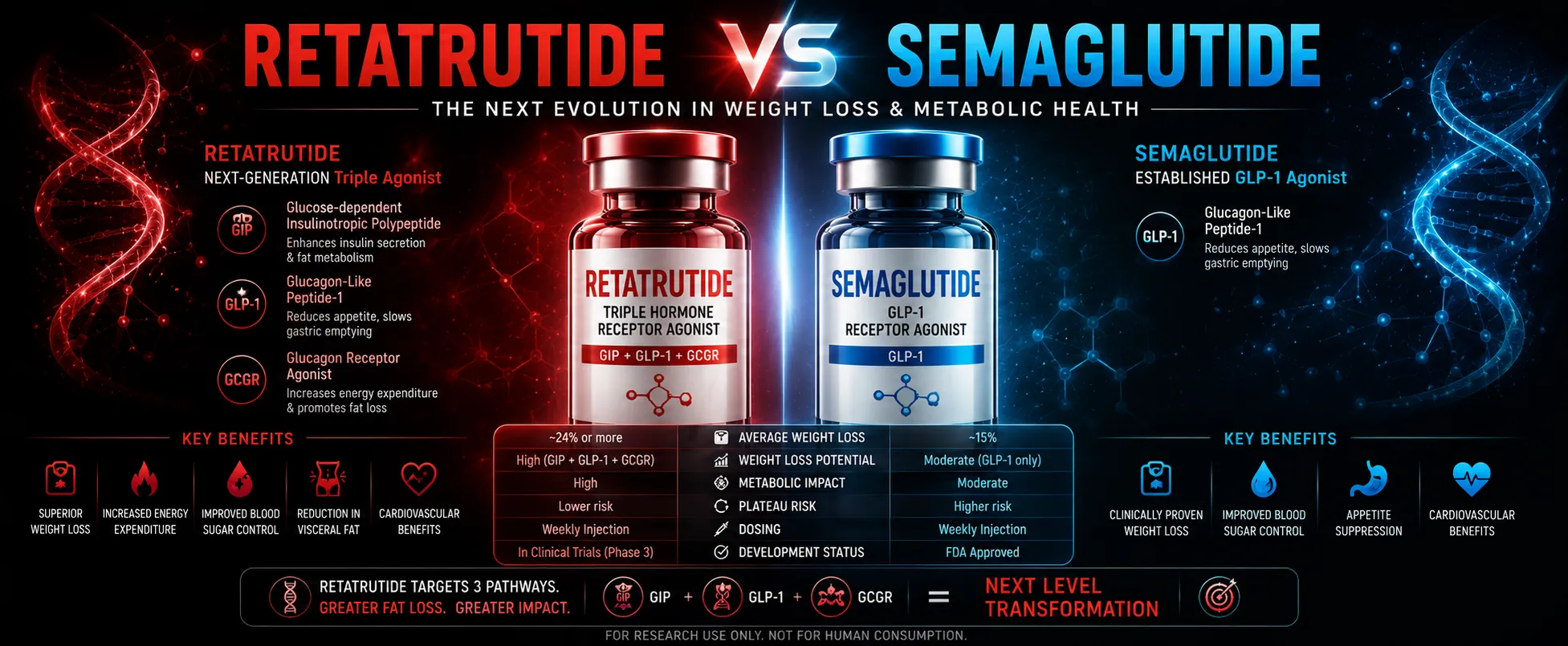
Retatrutide vs Semaglutide: UK Research Comparison 2026
This reference is strictly for laboratory and in vitro research purposes. Not for human or animal consumption. Not a medicine, food, cosmetic, or dietary supplement. Not approved by the MHRA.
Overview
Retatrutide and Semaglutide are both synthetic peptides used in metabolic research, but they differ fundamentally in receptor targets and mechanisms. Retatrutide is a triple agonist at the GLP-1, GIP, and glucagon receptors, while Semaglutide is a selective, long-acting GLP-1 receptor agonist.
For UK research laboratories, the choice between these peptides depends on the research question: Retatrutide enables the study of multi-receptor metabolic integration, while Semaglutide provides a clean model for isolated GLP-1 receptor pharmacology and sustained incretin signalling.
This comparison covers molecular structure, mechanism of action, research applications, cellular models, and sourcing standards for both compounds.
Molecular Structure Comparison
Retatrutide
- Sequence: 39 amino acids with C20 fatty-diacid conjugate
- Molecular weight: ~4,700 Da
- Key modifications: N-terminal fatty-diacid via γ-Glu-2xAdo linker; triple receptor affinity
- Half-life: ~5–7 days (albumin binding)
Semaglutide
- Sequence: 31 amino acids with C18 fatty-diacid chain
- Molecular weight: ~4,114 Da
- Key modifications: Aib at position 8 (DPP-4 resistance); C18 fatty-diacid at Lys26 (albumin binding)
- Half-life: ~7 days (albumin binding + DPP-4 resistance)
Structural Differences
Retatrutide is 8 amino acids longer than Semaglutide and contains modifications conferring affinity for GIP and glucagon receptors in addition to GLP-1. Both peptides use fatty-diacid conjugation for albumin binding and extended half-life, but Retatrutide's C20 chain is longer than Semaglutide's C18 chain. The additional receptor targets in Retatrutide create a more complex pharmacological profile in research models.
Mechanism of Action Comparison
Retatrutide: Triple Agonist Mechanism
Retatrutide activates three distinct receptor systems:
- GLP-1 receptor: Enhances glucose-dependent insulin secretion, suppresses glucagon, delays gastric emptying, activates satiety circuits
- GIP receptor: Amplifies insulin secretion, promotes adipose lipid storage, supports bone formation
- Glucagon receptor: Increases hepatic glucose output, stimulates lipolysis, raises energy expenditure
The triple agonism creates a balanced metabolic profile where the glucagon component counteracts the insulinotropic effects of GLP-1 and GIP, producing unique research questions about metabolic signal integration.
Semaglutide: Selective GLP-1 Agonism
Semaglutide selectively activates the GLP-1 receptor with high affinity and sustained kinetics:
- GLP-1 receptor: Produces sustained cAMP accumulation, enhanced insulin secretion, delayed gastric emptying, and central satiety signalling
- DPP-4 resistance: The Aib8 substitution prevents enzymatic degradation, maintaining receptor occupancy for extended periods
- Albumin binding: The C18 fatty-diacid chain creates a circulating reservoir, enabling continuous receptor activation
Key Research Differences
- Retatrutide produces multi-receptor metabolic effects with potential receptor crosstalk
- Semaglutide provides a cleaner model for studying isolated GLP-1 receptor pharmacology
- Retatrutide's glucagon activity adds energy expenditure and hepatic glucose output signals absent in Semaglutide
- Semaglutide's sustained GLP-1 activation is ideal for studying receptor desensitisation and long-term signalling
Research Applications Comparison
Retatrutide Research Applications
- Multi-receptor metabolic integration studies
- Energy homeostasis and metabolic flexibility research
- Comparative pharmacology with single and dual agonists
- Receptor crosstalk and biased agonism studies
- Class B GPCR oligomerisation research
Semaglutide Research Applications
- Sustained GLP-1 receptor activation studies
- Appetite and satiety circuit research
- Gastrointestinal motility and delayed gastric emptying studies
- Receptor desensitisation and downregulation research
- Comparative incretin pharmacology with shorter-acting analogues
When to Choose Retatrutide
- Research questions involve multi-receptor metabolic regulation
- Studying the interplay between incretin and glucagon signalling
- Examining receptor crosstalk and signal integration
- Comparing triple agonism to single or dual agonist approaches
When to Choose Semaglutide
- Research questions require isolated GLP-1 receptor pharmacology
- Studying sustained receptor activation and desensitisation
- Examining central satiety mechanisms without confounding receptor signals
- Comparing long-acting vs short-acting incretin agonists
Cellular Models Comparison
Retatrutide Cellular Models
- Beta-cell lines (MIN6, INS-1) for insulin secretion with multi-receptor contributions
- Primary hepatocytes for glucagon-mediated glucose output
- 3T3-L1 adipocytes for GIP receptor-mediated lipid storage
- Transfected cell lines expressing GLP-1, GIP, and glucagon receptors for binding affinity ratios
- Multi-cellular co-culture systems for paracrine signalling studies
Semaglutide Cellular Models
- Beta-cell lines and isolated islets for sustained insulin secretion
- Primary hepatocytes for glucagon suppression studies
- Hypothalamic and brainstem neuronal cultures for satiety signalling
- Gastric smooth muscle strips for motility studies
- Transfected GLP-1 receptor cell lines for binding and desensitisation kinetics
Comparative Experimental Design
Researchers often use both peptides in parallel to compare:
- Insulin secretion amplitude (Retatrutide's multi-receptor amplification vs Semaglutide's sustained GLP-1)
- Glucagon dynamics (Retatrutide's stimulation vs Semaglutide's suppression)
- Lipid metabolism (Retatrutide's GIP-mediated storage vs Semaglutide's lipolysis)
- Receptor occupancy kinetics over extended incubations
UK Sourcing and Purity Standards
Both Retatrutide and Semaglutide require high-purity research-grade materials for valid experimental results.
Retatrutide Sourcing Requirements
- ≥98% purity (HPLC), ≥99% preferred
- Mass spectrometry confirming 39-amino-acid sequence and C20 fatty-diacid conjugate
- Molecular weight verification (~4,700 Da)
- Batch-specific COA with endotoxin levels
- Research-use-only labelling
Semaglutide Sourcing Requirements
- ≥98% purity (HPLC), ≥99% preferred
- Mass spectrometry confirming 31-amino-acid sequence, Aib8 substitution, and C18 fatty-diacid chain
- Molecular weight verification (~4,114 Da)
- Batch-specific COA with endotoxin levels
- Research-use-only labelling
UK Legal Status
Both peptides are not controlled substances under the Misuse of Drugs Act 1971 and are not scheduled under the Psychoactive Substances Act 2016. They are classified as research peptides and are not licensed as medicines by the MHRA.
Frequently Asked Questions
References
- [1] Rosenstock J et al. Triple hormone receptor agonist retatrutide for obesity—A phase 2 trial. N Engl J Med 2023;389:138-151.
- [2] Knudsen LB et al. The discovery and development of liraglutide and semaglutide. Front Endocrinol 2019;10:155.
- [3] Coskun T et al. LY3437943, a novel triple glucagon, GIP, and GLP-1 receptor agonist. Cell Metab 2022;34:1234-1247.
- [4] Drucker DJ. Mechanisms of action and therapeutic application of glucagon-like peptide-1. Cell Metab 2018;27:740-756.
- [5] Nauck MA et al. GLP-1 receptor agonists and GIP receptor agonists: Mechanisms and clinical applications. Nat Rev Endocrinol 2021;17:165-176.
For laboratory and in vitro research use only. Not for human consumption. Not a medicine. Nothing in this article constitutes medical advice. UK researchers are responsible for compliance with the Human Medicines Regulations 2012 and Misuse of Drugs Regulations 2001 where applicable.