
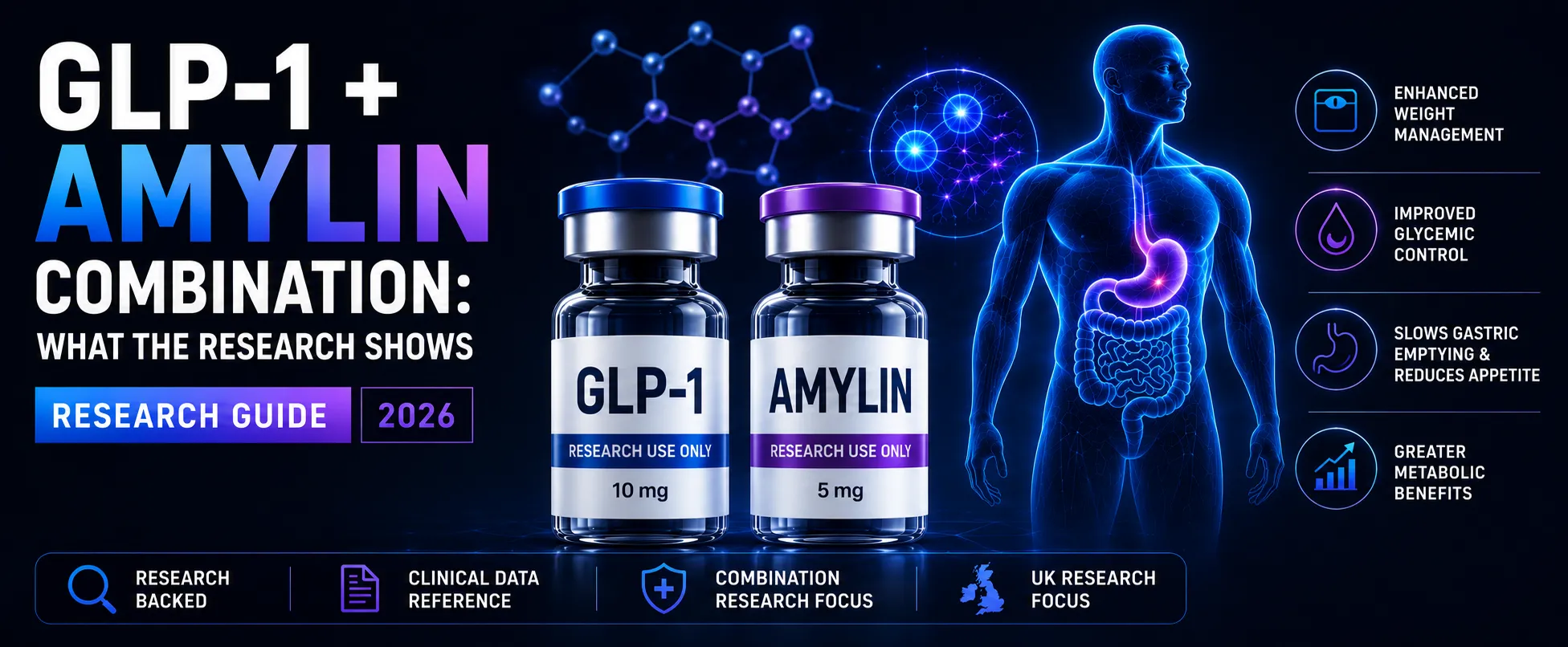
GLP-1 + Amylin Combination: What the Research Shows
This reference is strictly for laboratory and in vitro research purposes. Not for human or animal consumption. Not a medicine, food, cosmetic, or dietary supplement. Not approved by the MHRA.
Why combine them?
GLP-1 receptor agonists work by mimicking a gut hormone that tells your brain you're full, slows down gastric emptying, and boosts insulin secretion when blood sugar's high. But there's another hormone — amylin — that does something similar through different receptors, and the two pathways aren't redundant. They're complementary.
Amylin is co-secreted with insulin from pancreatic beta cells — which means people with impaired beta-cell function have less of both. It acts on the area postrema in the brainstem, triggering satiety signals that are distinct from GLP-1's CNS effects. It also delays gastric emptying (through a different mechanism than GLP-1) and suppresses glucagon secretion.
So the idea is simple: hit both pathways at once, and you get additive or even synergistic effects. You don't need higher doses of either drug, which means you might avoid the worst of the GI side effects. Plus, amylin doesn't cause hypoglycaemia on its own, so there's no extra safety risk.
Two approaches have emerged in the clinic. Novo Nordisk went with cagrilintide — a dual amylin and calcitonin receptor agonist (DACRA) — combined with semaglutide, branded as CagriSema. Eli Lilly went a different route with eloralintide, a more selective amylin receptor agonist that avoids calcitonin receptor activation. Both showed strong data in 2025.
CagriSema (cagrilintide + semaglutide)
CagriSema is a once-weekly fixed-dose combination of cagrilintide 2.4 mg and semaglutide 2.4 mg. Two Phase 3 trials published in NEJM in June 2025 — REDEFINE 1 and REDEFINE 2 — showed what this dual-pathway approach can do.
REDEFINE 1 — adults without diabetes
3,417 participants with BMI ≥30 (or ≥27 with at least one obesity-related complication) were randomised 21:3:3:7 to CagriSema, semaglutide alone, cagrilintide alone, or placebo. At 68 weeks, the estimated mean weight loss was:
| Group | Mean weight loss |
|---|---|
| CagriSema | −20.4% |
| Semaglutide | −14.9% |
| Cagrilintide | −11.5% |
| Placebo | −3.0% |
In the treatment-adherent analysis, CagriSema hit −22.7%. More striking: 40.4% of adherent CagriSema participants lost at least 25% of their body weight. More than half of participants (50.7%) moved from having obesity to a BMI below the obesity threshold — compared to just 10.2% on placebo.
GI side effects were common — 79.6% in the CagriSema group reported at least one GI event, versus 39.9% with placebo. Nausea, diarrhoea, and vomiting were the most frequent, though the paper describes them as "mainly transient and mild-to-moderate in severity."
REDEFINE 2 — adults with type 2 diabetes
1,206 participants with BMI ≥27 and HbA1c 7–10% were randomised 3:1 to CagriSema or placebo. The results were more modest, which you'd expect in a T2D population: −13.7% with CagriSema versus −3.4% with placebo (full adherence: −15.7%). But the glycemic data were impressive — 73.5% of CagriSema patients hit an HbA1c of ≤6.5%, versus 15.9% on placebo.
The GI tolerability was similar to REDEFINE 1: 72.5% in the CagriSema group reported GI events (34.4% placebo). No new safety signals emerged.
What these numbers suggest: the combination clearly beats either monotherapy, but the effect size shrinks in people with diabetes, and tolerability remains the main practical constraint.
Eloralintide — Lilly's selective approach
Lilly took a different pharmacological tack with eloralintide. Instead of a dual amylin/calcitonin agonist like cagrilintide, eloralintide is a selective amylin receptor agonist — it activates amylin receptors without hitting the calcitonin receptor. The idea is to get the satiety and metabolic benefits of amylin signalling while avoiding any calcitonin-related effects (which can include nausea and potentially reduced bone turnover).
The Phase 2 data were published in The Lancet in November 2025. 263 participants with obesity or overweight (mean BMI 39.1, mean weight 109.1 kg) were randomised across six dosing arms — 1 mg, 3 mg, 6 mg, 9 mg, and two dose-escalation schemes (6→9 mg and 3→6→9 mg) — versus placebo.
Results at 48 weeks (efficacy estimand):
| Dose | Mean weight loss |
|---|---|
| 1 mg | −9.5% |
| 3 mg | −12.4% |
| 6 mg | −17.6% |
| 9 mg | −20.1% |
| 6→9 mg escalation | −19.9% |
| 3→6→9 mg escalation | −16.4% |
| Placebo | −0.4% |
The dose-response curve is clear — eloralintide works in a graded fashion, with the highest dose approaching the weight loss you'd expect from tirzepatide or CagriSema, but as a monotherapy.
The tolerability story matters here. Nausea rates in the 6 mg arm hit 64%, but in the 3→6→9 mg slow-escalation arm, it dropped to 25% — comparable to placebo (14%). Fatigue was the next most common event, ranging from 0–46% depending on dose and escalation speed. The takeaway: how you ramp up the dose matters as much as the dose itself.
Lilly plans to start Phase 3 enrolment by end of 2025, both as monotherapy and in combination with incretin therapies.
How they compare
Cagrilintide and eloralintide both target the amylin system, but the pharmacology differs in ways that might matter for research.
Cagrilintide is a dual amylin and calcitonin receptor agonist (DACRA). The calcitonin receptor component adds an extra signalling pathway — calcitonin receptors are expressed in bone, kidney, and certain CNS regions. Whether this contributes to efficacy or just adds side effects isn't fully settled. The REDEFINE data suggest the combination is effective, but the GI side effect burden is substantial.
Eloralintide is selective for the amylin receptor (specifically the AMY1, AMY2, and AMY3 subtypes formed by heterodimerisation of the calcitonin receptor with RAMP proteins). By avoiding calcitonin receptor activation, Lilly may have reduced one source of nausea. The Phase 2 data support this — the slow-escalation cohorts had GI tolerability close to placebo, while still achieving 16–20% weight loss.
The head-to-head comparison we don't have is CagriSema vs eloralintide combined with a GLP-1. CagriSema uses semaglutide; eloralintide hasn't been trialled in a fixed-dose combination yet (though Lilly's Phase 3 plans include incretin combo studies). The monotherapy data from eloralintide (20.1% at 9 mg) is notable — that's approaching the efficacy of CagriSema's 20.4% but as a single agent, not a combination.
For UK researchers, the key difference is practical: CagriSema is further along in clinical development (Phase 3 completed), while eloralintide is entering Phase 3 now. The choice of reference compound depends on whether your research question is about dual-pathway combination strategies (CagriSema) or selective amylin agonism (eloralintide).
What we still don't know
The REDEFINE and eloralintide trials answered a lot, but plenty of questions remain:
Durability. Both trials ran for 48–68 weeks. We don't know how these effects hold up over 2–5 years, or whether weight regain kinetics differ from GLP-1 monotherapy. The amylin system may have different compensatory mechanisms than GLP-1.
Optimal combination partners. CagriSema uses semaglutide. Would cagrilintide + tirzepatide do better? Lilly plans to study eloralintide + incretin combinations, but no data yet. The triple-agonist question (amylin + GLP-1 + GIP) is open.
Calcitonin receptor effects. Cagrilintide activates calcitonin receptors. What does that mean for bone metabolism, calcium handling, or renal function over the long term? The calcitonin receptor is expressed in osteoclasts — chronic activation could theoretically affect bone turnover. No signal yet, but the trials weren't powered for that.
Selectivity vs breadth. Is selective amylin agonism (eloralintide) better than dual amylin/calcitonin agonism (cagrilintide)? The data suggest eloralintide might have a tolerability edge, but without a head-to-head trial, that's speculative. Different receptors, different signalling profiles, different side effect patterns.
Combination with triple agonists. Retatrutide already hits GLP-1, GIP, and glucagon. Would adding amylin signalling — either via combination or a single molecule — push efficacy further? That's a basic research question UK labs could explore using reference compounds.
Which patients benefit most. The REDEFINE 2 data showed smaller effects in T2D. Is that an inherent limitation of the amylin-GLP-1 combination in diabetes, or a dose optimisation issue?
UK research context
For UK research laboratories working on metabolic disease, the GLP-1 + amylin combination space offers several reference compounds:
- Semaglutide — the GLP-1 component of CagriSema, available as a standalone research peptide for in vitro and animal studies
- Tirzepatide — dual GLP-1/GIP agonist, a comparator for studies examining whether dual incretin agonism outperforms GLP-1 alone in amylin combination models
- Retatrutide — triple GLP-1/GIP/glucagon agonist, useful for studying how amylin signalling might interact with multi-receptor metabolic pathways
Cagrilintide and eloralintide are proprietary clinical-stage compounds and not available as laboratory research peptides. But researchers can study the amylin system using standard laboratory reagents: rat amylin, human amylin (which is amyloidogenic and requires handling precautions), or selective amylin receptor ligands for in vitro receptor pharmacology.
The key research questions UK labs can address right now include:
- Does amylin receptor activation produce additive effects to GLP-1, GIP, and glucagon in cellular signalling assays?
- What's the dose-response relationship for amylin-mediated satiety signalling in CNS-derived cell models?
- How does chronic amylin exposure affect beta-cell function and insulin secretion in islet culture models?
- Can amylin receptor ligands be used to study receptor-RAMP interactions and subtype selectivity in transfected cell systems?
All standard UK peptide research regulations apply. These peptides are not controlled substances under the Misuse of Drugs Act. For in vitro and animal research only — no human use.
Frequently Asked Questions
References
- [1] Garvey WT et al. Coadministered cagrilintide and semaglutide in adults with overweight or obesity. N Engl J Med 2025;393:2455-2468.
- [2] Davies MJ et al. Cagrilintide-semaglutide in adults with overweight or obesity and type 2 diabetes. N Engl J Med 2025;393:2469-2480.
- [3] Lutz T et al. Eloralintide, a selective amylin receptor agonist for the treatment of obesity: a 48-week phase 2 trial. Lancet 2025;406:2189-2200.
- [4] Enebo LB et al. Safety and efficacy of cagrilintide in adults with overweight or obesity: a phase 2 trial. Lancet 2021;397:1736-1748.
- [5] Hay DL et al. Amylin receptor pharmacology and therapeutic potential. Br J Pharmacol 2022;179:848-864.
- [6] Zac-Varghese S et al. The role of amylin in energy homeostasis and metabolic regulation. Peptides 2023;161:170942.
- [7] Müller TD et al. Anti-obesity drug discovery: advances and challenges. Nat Rev Drug Discov 2022;21:201-223.
For laboratory and in vitro research use only. Not for human consumption. Not a medicine. Nothing in this article constitutes medical advice. UK researchers are responsible for compliance with the Human Medicines Regulations 2012 and Misuse of Drugs Regulations 2001 where applicable.