
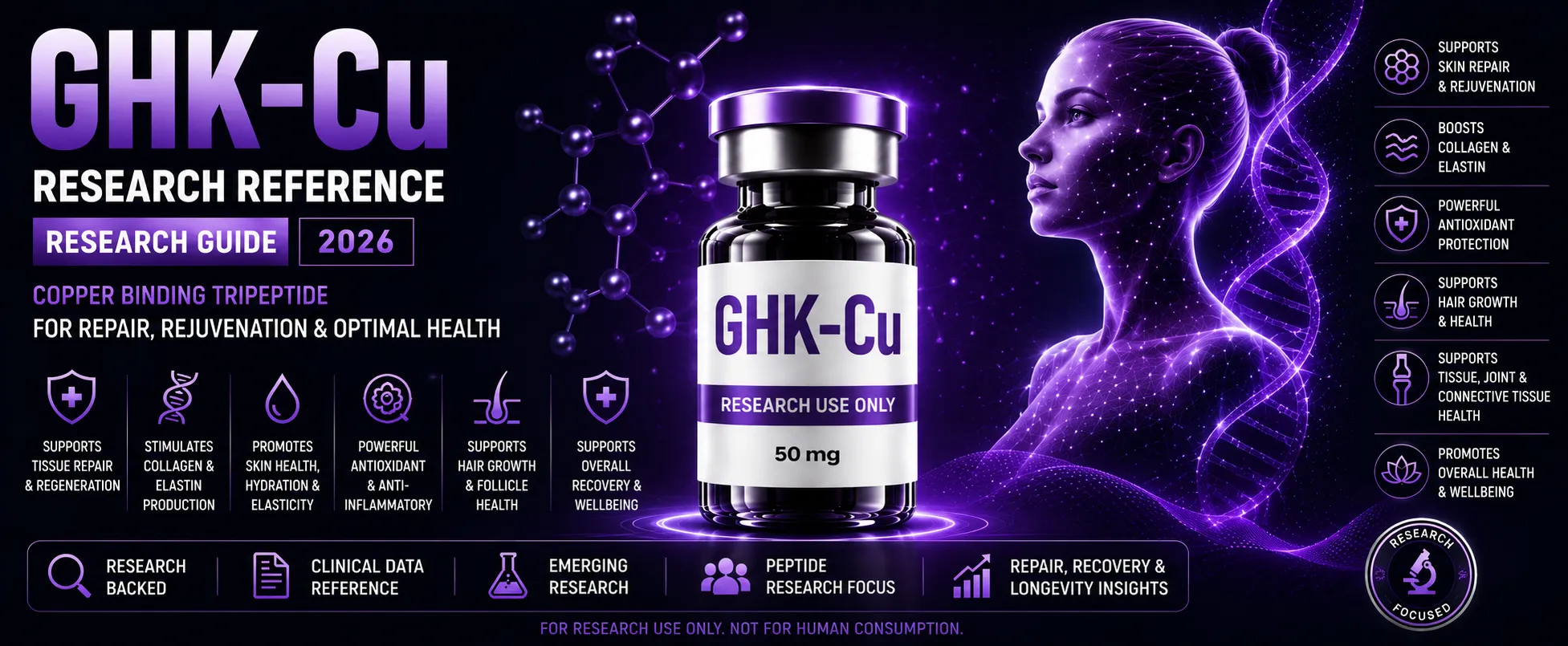
GHK-Cu UK: Research Reference 2026
This reference is strictly for laboratory and in vitro research purposes. Not for human or animal consumption. Not a medicine, food, cosmetic, or dietary supplement. Not approved by the MHRA.
Overview
GHK-Cu (glycyl-L-histidyl-L-lysine copper) is a copper-binding tripeptide that occurs naturally in human plasma, saliva, and urine. The peptide was first identified in 1973 by Pickart and has been studied extensively for its role in wound healing, tissue regeneration, and extracellular matrix remodelling.
The peptide binds copper ions with high affinity, forming a stable complex that delivers copper to tissues and modulates gene expression. GHK-Cu levels decline with age, falling from approximately 200 ng/mL at age 20 to about 80 ng/mL at age 60.
For UK research laboratories, GHK-Cu serves as a reference compound for studies examining copper metabolism, wound healing, and tissue regeneration. The peptide is not licensed as a medicine and is supplied for research use only.
Molecular Structure
GHK-Cu is a tripeptide-copper complex with the following structural characteristics:
- Sequence: Glycyl-L-histidyl-L-lysine (3 amino acids)
- Molecular weight (free peptide): ~340 Da
- Molecular weight (copper complex): ~400 Da
- Copper binding: High affinity (2:1 peptide:copper ratio)
- Coordination: Copper binds to nitrogen atoms from the glycine α-amine, histidine imidazole, and lysine ε-amine
The copper coordination is critical for biological activity. The 2:1 stoichiometry means two GHK molecules bind one copper ion, creating a stable square-planar complex. This copper delivery mechanism is central to the peptide's biological effects.
Mechanism of Action
GHK-Cu operates through several mechanisms in cellular and in vitro models:
Copper Delivery
GHK-Cu functions as a copper carrier, delivering copper to tissues in a bioavailable form. Copper is essential for the activity of enzymes involved in collagen cross-linking (lysyl oxidase), antioxidant defence (superoxide dismutase), and angiogenesis. In cellular models, GHK-Cu increases copper-dependent enzyme activity.
Gene Expression Modulation
Transcriptomic studies show GHK-Cu modulates the expression of approximately 4,000 genes, primarily those involved in tissue remodelling, antioxidant defence, and anti-inflammatory pathways. The mechanism involves copper-mediated effects on transcription factor activity and epigenetic regulation.
Wound Healing
The peptide promotes wound healing through multiple pathways: stimulation of fibroblast migration, increased collagen and elastin synthesis, enhanced angiogenesis, and modulation of growth factor expression. In cellular models, GHK-Cu accelerates wound closure in scratch assays.
Anti-Inflammatory Effects
GHK-Cu reduces inflammatory cytokine production in cellular models. The peptide modulates TGF-β signalling, reducing fibrotic responses while promoting regenerative tissue repair. The anti-inflammatory effects are examined in macrophage and fibroblast co-cultures.
Antioxidant Activity
The copper complex has antioxidant activity, scavenging free radicals and reducing oxidative stress in cellular models. The peptide upregulates antioxidant enzyme expression, including superoxide dismutase and catalase.
Research Applications
GHK-Cu is employed across multiple research domains in UK laboratories:
Wound Healing Research
In vitro studies examine GHK-Cu's effects on wound closure, fibroblast migration, and collagen synthesis. Researchers use scratch assays, organotypic cultures, and tissue explants to examine the peptide's regenerative effects.
Skin and Dermal Research
Dermal fibroblast and keratinocyte cultures are used to examine GHK-Cu's effects on extracellular matrix production, skin barrier function, and cellular senescence. The peptide's effects on collagen types I, III, and IV are quantified.
Hair Follicle Research
Dermal papilla cells and hair follicle cultures examine GHK-Cu's effects on hair growth, follicle size, and hair cycle regulation. The peptide's stimulation of follicle cell proliferation is studied in organ cultures.
Anti-Ageing Research
Cellular senescence models examine GHK-Cu's effects on senescence markers, telomere maintenance, and age-related gene expression changes. The peptide's upregulation of tissue repair genes is relevant for ageing research.
Comparative Regenerative Peptides
GHK-Cu is compared to BPC-157, TB-500, and other regenerative peptides in cellular studies. Research questions examine whether copper delivery produces unique regenerative effects compared to peptide-only approaches.
Cellular and In Vitro Models
UK research laboratories employ several standard cellular models for GHK-Cu studies:
Fibroblast Scratch Assays
Primary dermal fibroblasts are used in scratch wound assays to measure migration and proliferation. Endpoints include wound closure rate, collagen I/III deposition, and elastin synthesis. The copper complex is compared to free GHK peptide.
Collagen Synthesis
Fibroblast cultures are used to measure collagen production in response to GHK-Cu. Hydroxyproline assays, collagen ELISAs, and Sirius Red staining quantify extracellular matrix deposition. Type-specific collagen synthesis (I, III, IV) is examined by qPCR and Western blot.
Endothelial Tube Formation
HUVEC cultures are used to examine angiogenic effects. Tube formation, sprouting, and VEGF production are measured in response to GHK-Cu treatment. The copper-dependent mechanism is confirmed by comparison with copper-free controls.
Antioxidant Assays
Cellular antioxidant capacity is measured by ROS scavenging, superoxide dismutase activity, and lipid peroxidation markers. The copper complex's antioxidant effects are compared to free GHK and copper salts.
Dermal Papilla Cells
Hair follicle dermal papilla cells are used to examine proliferation and hair growth factor secretion. The peptide's effects on IGF-1, VEGF, and other follicle-regulatory factors are quantified.
Safety Profile in Preclinical Research
GHK-Cu's safety profile is based on preclinical cellular and animal studies. In vitro toxicology screens have not identified significant cytotoxicity at research-relevant concentrations.
In animal studies, the peptide has been well tolerated at standard research doses. The endogenous nature of GHK (naturally present in human plasma) suggests low inherent toxicity. No organ-specific toxicity has been reported at standard doses.
The copper component raises considerations about copper overload at very high doses, though the 2:1 peptide:copper ratio and standard research concentrations are not associated with copper toxicity. The peptide's role in copper transport may actually protect against copper-mediated oxidative damage.
Standard laboratory precautions apply: GHK-Cu is a research peptide, not a medicine or dietary supplement. It is supplied for in vitro and laboratory animal research only.
Reconstitution and Handling
GHK-Cu is supplied as a lyophilised powder (usually as the copper complex) in research-grade vials. Standard laboratory preparation:
- Reconstitution: Bacteriostatic water (0.9% benzyl alcohol) is recommended for laboratory preparations
- Concentration: Typical research stock concentrations range from 1–10 mg/mL depending on assay requirements
- Storage: Lyophilised powder at −20 °C; reconstituted solution at 2–8 °C, protected from light
- Stability: Reconstituted solutions are stable for 7–14 days under refrigeration; for extended studies, aliquot and freeze at −20 °C
- Solubility: The copper complex is generally soluble in aqueous solutions; the blue-violet colour confirms intact copper coordination
- Copper confirmation: The characteristic blue-violet colour of the reconstituted solution indicates intact copper complex formation
The copper complex is light-sensitive; prolonged light exposure may cause copper photoreduction. Protect solutions from light during storage and incubation.
UK Research Status
GHK-Cu is not a controlled substance under the UK Misuse of Drugs Act 1971 and is not scheduled under the Psychoactive Substances Act 2016. It is classified as a research peptide for laboratory use and is not licensed as a medicine by the MHRA.
For UK research laboratories, GHK-Cu is available as a research-grade reference material. Sourcing should include:
- Certificate of Analysis confirming ≥98% purity (HPLC)
- Mass spectrometry identity confirmation (molecular weight ~400 Da for copper complex)
- Copper stoichiometry confirmation (2:1 peptide:copper ratio)
- Batch-specific testing documentation
- Appropriate storage and shipping conditions (cold chain)
- Research-use-only labelling
Researchers should ensure compliance with institutional ethics approvals for animal studies, and adhere to standard laboratory safety protocols for peptide handling.
Frequently Asked Questions
References
- [1] Pickart L. The human tripeptide GHK and tissue remodeling. J Biomater Sci Polym Ed 2008;19:969-988.
- [2] Pickart L et al. GHK peptide as a natural modulator of multiple cellular pathways in skin regeneration. Biomed Res Int 2015;2015:648108.
- [3] Pickart L, Margolina A. Regenerative and protective actions of the GHK-Cu peptide in the light of the new gene data. Int J Mol Sci 2018;19:1987.
- [4] Maquart FX et al. In vivo stimulation of connective tissue accumulation by the tripeptide-copper complex GHK-Cu. J Clin Invest 1993;92:2368-2376.
- [5] Simeon A et al. Expression and activation of matrix metalloproteinases in wounds: modulation by the tripeptide-copper complex GHK-Cu. J Invest Dermatol 1999;112:957-964.
For laboratory and in vitro research use only. Not for human consumption. Not a medicine. Nothing in this article constitutes medical advice. UK researchers are responsible for compliance with the Human Medicines Regulations 2012 and Misuse of Drugs Regulations 2001 where applicable.