
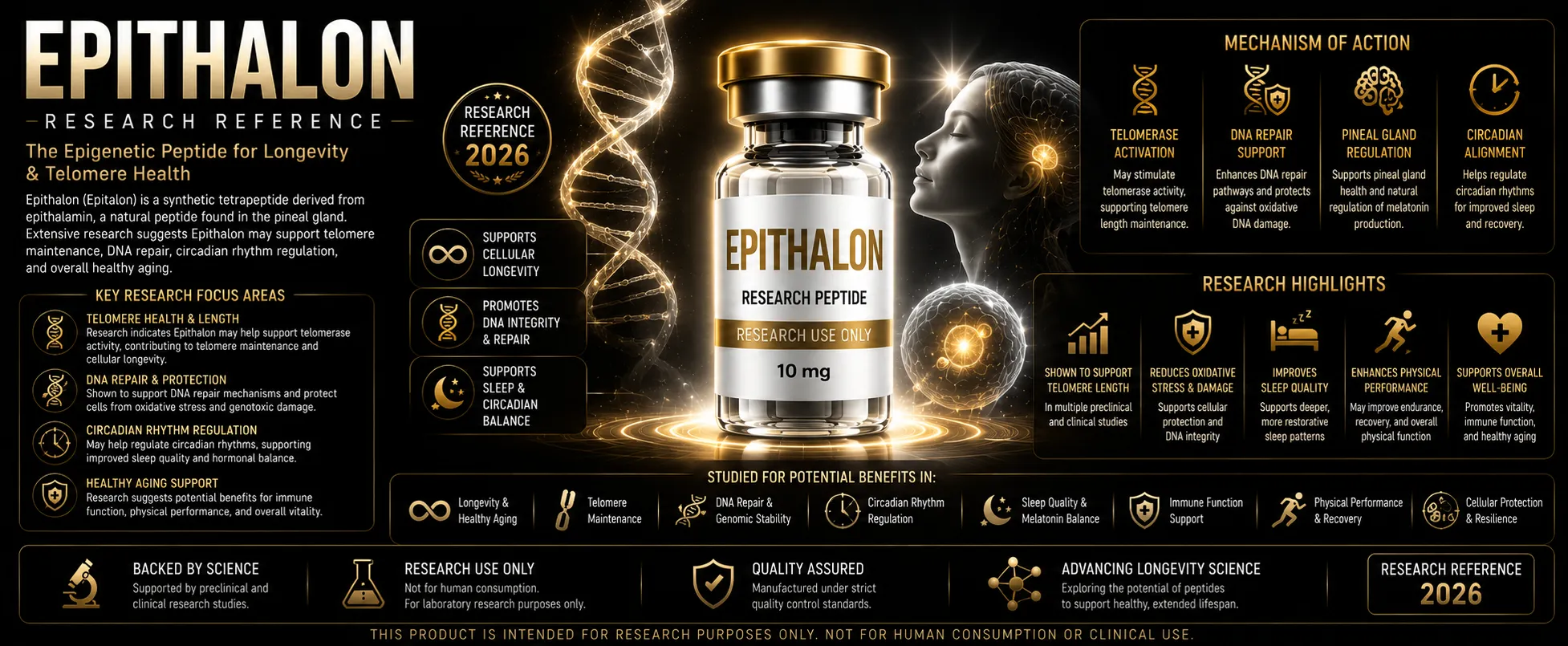
Epithalon UK: Research Reference 2026
This reference is strictly for laboratory and in vitro research purposes. Not for human or animal consumption. Not a medicine, food, cosmetic, or dietary supplement. Not approved by the MHRA.
Overview
Epithalon is a synthetic tetrapeptide (Ala-Glu-Asp-Gly) with a molecular weight of approximately 390.4 Da. The peptide was originally isolated from the pineal gland and was subsequently synthesised to study its effects on cellular ageing, telomerase activity, and the regulation of biological rhythms.
The peptide is the shortest of the research peptides with only four amino acids. Its small size contributes to rapid cellular uptake and direct interaction with nuclear targets. The sequence is conserved across species and represents a biologically active fragment of the larger pineal peptide complex.
For UK research laboratories, Epithalon serves as a reference compound for studies examining telomerase regulation, cellular senescence, and the pineal-axis contribution to ageing mechanisms. The peptide is not licensed as a medicine and is supplied for research use only.
Molecular Structure
Epithalon is a synthetic tetrapeptide with the following structural characteristics:
- Sequence: Ala-Glu-Asp-Gly (4 amino acids)
- Molecular weight: Approximately 390.4 Da
- Origin: Synthetic version of a pineal gland peptide
- Size: One of the smallest bioactive peptides in research use
- C-terminus: Free carboxyl group
The peptide's small size allows rapid diffusion across cellular membranes and direct nuclear localisation. The negatively charged glutamate and aspartate residues contribute to interactions with DNA and nuclear proteins. The N-terminal alanine provides stability, while the glycine C-terminus contributes to conformational flexibility.
Mechanism of Action
Epithalon operates through several mechanisms in cellular and in vitro models:
Telomerase Activation
The primary mechanism of Epithalon in research models is the upregulation of telomerase activity. Telomerase is a reverse transcriptase that adds telomeric repeats to chromosome ends, compensating for the end-replication problem in dividing cells. In cellular models, Epithalon increases telomerase expression and activity, particularly in fibroblast and epithelial cell cultures.
Pineal Axis Regulation
Epithalon is studied in the context of pineal gland function and melatonin secretion. The peptide modulates the expression of enzymes involved in melatonin synthesis (N-acetyltransferase, hydroxyindole-O-methyltransferase) in pineal cell cultures. The pineal axis is central to circadian rhythm regulation and its disruption is associated with ageing.
Cellular Senescence
In cellular senescence models, Epithalon is examined for its effects on senescence markers (p16, p21, SA-β-galactosidase) and replicative lifespan. The peptide is studied in the context of extending cellular replicative capacity through telomerase-mediated telomere maintenance.
DNA Repair and Genomic Stability
Epithalon is studied for its effects on DNA repair capacity and chromosomal stability. The peptide may influence the expression of DNA repair enzymes and reduce chromosomal aberrations in cellular models of genotoxic stress.
Gene Expression Modulation
Microarray and transcriptomic studies show Epithalon modulates the expression of genes involved in cell cycle regulation, apoptosis, and stress resistance. The peptide's effects on gene expression are examined in the context of cellular ageing and longevity pathways.
Research Applications
Epithalon is employed across multiple research domains in UK laboratories:
Telomerase Research
In vitro studies examine Epithalon's effects on telomerase activity in fibroblast, epithelial, and stem cell cultures. Researchers use the peptide to study telomerase regulation, telomere length maintenance, and the relationship between telomerase and cellular replicative lifespan.
Cellular Ageing Studies
Cellular senescence models examine Epithalon's effects on senescence markers, telomere attrition, and replicative capacity. The peptide is studied in the context of extending cellular lifespan through telomerase-mediated mechanisms and anti-senescence pathways.
Pineal Gland Research
Pineal cell cultures examine Epithalon's effects on melatonin synthesis, circadian rhythm gene expression, and pineal hormone secretion. The peptide's modulation of the pineal axis is studied in the context of biological rhythm regulation and age-related pineal decline.
Genomic Stability
Cellular models of genotoxic stress examine Epithalon's effects on DNA repair capacity, chromosomal aberrations, and genomic integrity. The peptide is studied for potential protective effects against oxidative DNA damage and radiation-induced cellular stress.
Comparative Longevity Peptides
Epithalon is compared to other longevity-related compounds (resveratrol, NAD+ precursors, sirtuin activators) in cellular studies. Research questions examine whether the telomerase-mediated mechanism produces distinct outcomes compared to metabolic or antioxidant approaches.
Cellular and In Vitro Models
UK research laboratories employ several standard cellular models for Epithalon studies:
Telomerase Activity Assays
Cellular extracts or recombinant telomerase are incubated with Epithalon, and telomerase activity is measured by TRAP assay (Telomeric Repeat Amplification Protocol). Endpoints include telomerase expression (qPCR, Western blot) and telomere length (Southern blot, qPCR).
Fibroblast Lifespan Studies
Primary human fibroblast cultures are serially passaged with Epithalon treatment, and population doublings are counted. Senescence markers (SA-β-gal, p16, p21) are measured at each passage. Telomere length is monitored throughout the replicative lifespan.
Pineal Cell Cultures
Pinealocyte cultures are used to examine Epithalon's effects on melatonin synthesis, N-acetyltransferase activity, and circadian rhythm gene expression (CLOCK, BMAL1, PER). The peptide is compared to melatonin and other pineal compounds.
DNA Repair Assays
Cells are exposed to UV radiation, hydrogen peroxide, or ionising radiation, then treated with Epithalon to examine DNA repair capacity. Endpoints include comet assay, γ-H2AX foci, and chromosomal aberration frequency.
Stem Cell Cultures
Mesenchymal stem cells and embryonic stem cells are used to examine Epithalon's effects on stem cell proliferation, differentiation, and telomere maintenance. The peptide's effects on stem cell replicative capacity are of particular interest in regenerative medicine research.
Safety Profile in Preclinical Research
Epithalon's safety profile is based on preclinical cellular and animal studies. In vitro toxicology screens using standard cell lines have not identified significant cytotoxicity at research-relevant concentrations (up to 100 μM).
In animal studies, the peptide has been well tolerated at standard research doses. The small size and natural amino acid composition contribute to favourable safety characteristics. The peptide does not appear to produce acute toxicity or organ-specific adverse effects in preclinical models.
The theoretical consideration of telomerase activation raises questions about cellular immortalisation, though the peptide's effects on telomerase are modest and context-dependent. Standard research doses are designed to study physiological regulation rather than supraphysiological stimulation.
Standard laboratory precautions apply: Epithalon is a research peptide, not a medicine or dietary supplement. It is supplied for in vitro and laboratory animal research only.
Reconstitution and Handling
Epithalon is supplied as a lyophilised powder in research-grade vials. Standard laboratory preparation:
- Reconstitution: Bacteriostatic water (0.9% benzyl alcohol) is recommended for laboratory preparations
- Concentration: Typical research stock concentrations range from 1–10 mg/mL depending on assay requirements
- Storage: Lyophilised powder at −20 °C; reconstituted solution at 2–8 °C, protected from light
- Stability: Reconstituted solutions are stable for 7–14 days under refrigeration; for extended studies, aliquot and freeze at −20 °C
- Solubility: The small peptide is readily soluble in aqueous solutions; minimal mixing required
- Light sensitivity: Protect from light during storage and use
The peptide's small size may result in non-specific binding to plastic surfaces; researchers should verify recovery rates. Pre-wetting tubes with BSA-containing buffer may reduce peptide loss. The peptide is relatively stable but should be protected from extremes of pH and temperature.
UK Research Status
Epithalon is not a controlled substance under the UK Misuse of Drugs Act 1971 and is not scheduled under the Psychoactive Substances Act 2016. It is classified as a research peptide for laboratory use and is not licensed as a medicine by the MHRA.
For UK research laboratories, Epithalon is available as a research-grade reference material. Sourcing should include:
- Certificate of Analysis confirming ≥98% purity (HPLC)
- Mass spectrometry identity confirmation (molecular weight ~390.4 Da)
- Batch-specific testing documentation
- Appropriate storage and shipping conditions (cold chain)
- Research-use-only labelling
Researchers should ensure compliance with institutional ethics approvals for animal studies, and adhere to standard laboratory safety protocols for peptide handling.
Frequently Asked Questions
References
- [1] Khavinson VKh et al. Epithalon peptide induces telomerase activity and telomere elongation in human somatic cells. Bull Exp Biol Med 2003;135:590-592.
- [2] Khavinson VKh et al. The effects of short peptides on gene expression. Bull Exp Biol Med 2009;147:248-251.
- [3] Anisimov VN et al. Effects of epitalon on biomarkers of aging, life span and spontaneous tumor incidence in female Swiss-derived SHR mice. Biogerontology 2003;4:193-202.
- [4] Khavinson VKh, Anisimov VN. Peptide regulation of ageing. J Anti Aging Med 2000;3:131-135.
- [5] Khavinson VKh et al. Pineal-regulating tetrapeptide epitalon improves eye retina condition in retinitis pigmentosa. Bull Exp Biol Med 2002;133:329-332.
For laboratory and in vitro research use only. Not for human consumption. Not a medicine. Nothing in this article constitutes medical advice. UK researchers are responsible for compliance with the Human Medicines Regulations 2012 and Misuse of Drugs Regulations 2001 where applicable.