
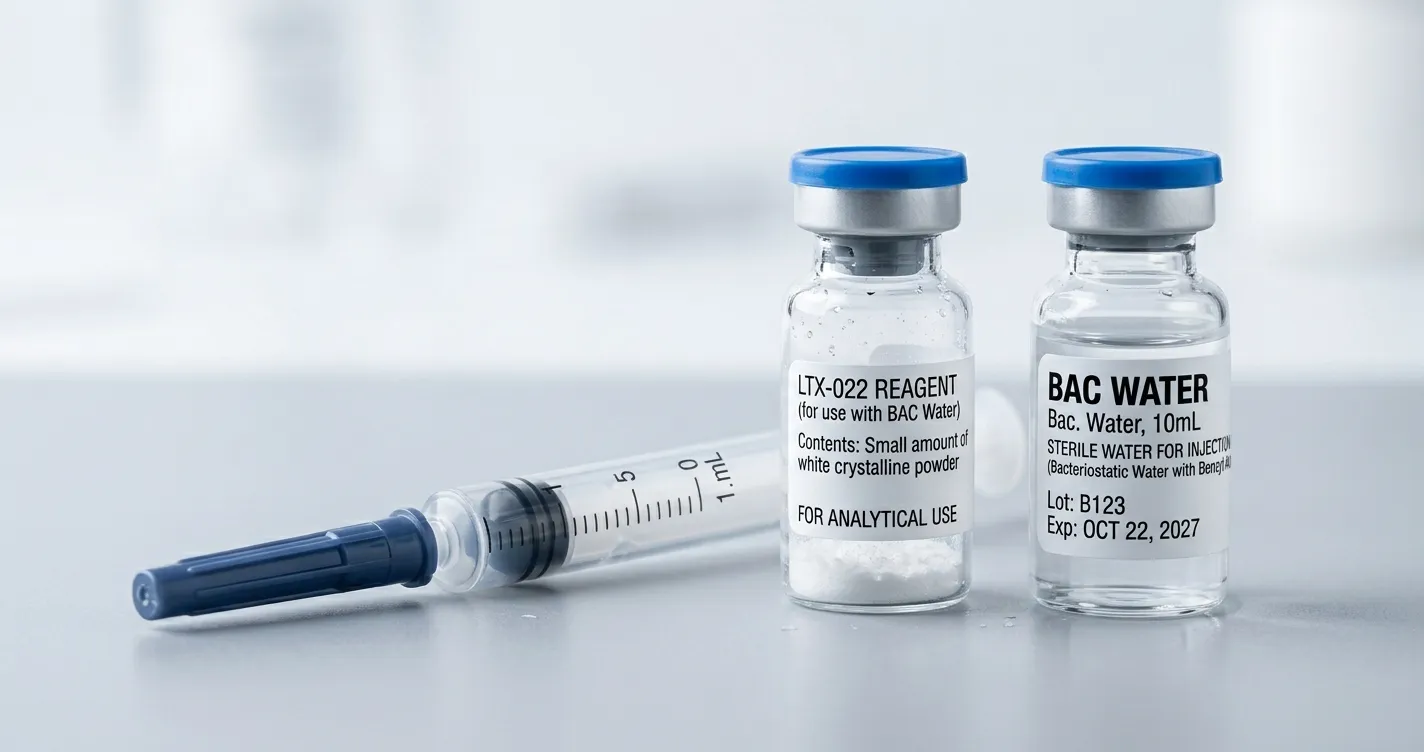
Bacteriostatic Water: Research Reconstitution Guide 2026
This reference is strictly for laboratory and in vitro research purposes. Not for human or animal consumption. Not a medicine, food, cosmetic, or dietary supplement. Not approved by the MHRA.
Overview
Bacteriostatic water (BAC water) is sterile water containing 0.9% (9 mg/mL) benzyl alcohol as a bacteriostatic preservative. It is the standard reconstitution medium for lyophilised peptides in research laboratories, providing a sterile, slightly preserved environment that inhibits bacterial growth while maintaining peptide stability.
The benzyl alcohol content acts as a bacteriostatic agent, preventing the growth of bacteria and fungi in the reconstituted solution. Unlike sterile water (which contains no preservative), bacteriostatic water allows reconstituted peptides to be stored for 7–14 days under refrigeration without significant microbial contamination risk.
For UK research laboratories, bacteriostatic water is an essential accessory for peptide reconstitution, enabling the preparation of stable, research-ready solutions from lyophilised peptide powders. Proper handling, storage, and use of bacteriostatic water are critical for maintaining peptide integrity and experimental reproducibility.
Composition and Properties
Bacteriostatic water has the following composition and properties:
- Composition: Sterile water (H2O) + 0.9% benzyl alcohol (C6H5CH2OH)
- Benzyl alcohol concentration: 9 mg/mL (0.9% w/v)
- pH: 4.5–7.0 (slightly acidic, optimal for peptide stability)
- Osmolarity: Approximately 300 mOsm/L (isotonic)
- Packaging: 3 mL or 10 mL sterile vials, multi-dose
- Storage: Room temperature (15–30 °C), protected from light
- Shelf life: 2–3 years from manufacture date when unopened
The benzyl alcohol acts as a bacteriostatic preservative by disrupting bacterial cell membrane integrity. It is effective against Gram-positive and Gram-negative bacteria, as well as fungi. The concentration of 0.9% is sufficient for antimicrobial activity while minimising potential effects on peptide stability and cellular assays.
Peptide Reconstitution Protocol
Standard laboratory reconstitution protocol for lyophilised peptides using bacteriostatic water:
Preparation
- Allow the peptide vial and bacteriostatic water vial to reach room temperature (reduces condensation)
- Wipe the rubber stoppers of both vials with an alcohol swab (70% isopropanol)
- Allow the alcohol to evaporate completely before piercing the stopper
Reconstitution Steps
- Draw the required volume of bacteriostatic water into a sterile syringe (typically 1–2 mL for 10 mg peptides)
- Inject the water slowly down the inside wall of the peptide vial (not directly onto the powder)
- Allow the water to gently flow over the lyophilised powder without forceful spraying
- Do not shake the vial; gently swirl or roll between palms to aid dissolution
- Allow the vial to stand for 5–10 minutes at room temperature to ensure complete dissolution
- Inspect the solution for clarity, particulates, or colour changes
Concentration Calculation
- 10 mg peptide in 1 mL = 10 mg/mL
- 10 mg peptide in 2 mL = 5 mg/mL
- Choose concentration based on assay requirements and dosing calculations
Important Notes
- Never use tap water, distilled water, or non-sterile water for reconstitution
- Do not shake vigorously (may cause foam formation and peptide denaturation)
- If the peptide does not dissolve completely, gentle warming to 37 °C (not exceeding) may aid dissolution
- Do not freeze-thaw reconstituted solutions repeatedly; aliquot for long-term storage
Storage and Handling
Proper storage and handling of bacteriostatic water and reconstituted peptides:
Bacteriostatic Water (Unopened)
- Store at room temperature (15–30 °C)
- Protect from direct light (store in original box or dark cabinet)
- Do not freeze (may compromise benzyl alcohol efficacy and vial integrity)
- Check expiry date before use; do not use expired vials
- Inspect for clarity, particles, or discolouration before opening
Reconstituted Peptide Solutions
- Store at 2–8 °C (refrigerator) in the original vial or aliquoted into sterile microcentrifuge tubes
- Use within 7–14 days for standard assays; aliquot and freeze at −20 °C for extended storage
- Protect from light (wrap vial in aluminium foil or store in amber container)
- Label with peptide name, concentration, reconstitution date, and expiry
- Do not store at room temperature for extended periods (increases degradation risk)
Aliquoting for Long-Term Storage
- Divide reconstituted solution into single-use aliquots (e.g., 100 μL per tube)
- Freeze immediately at −20 °C or −80 °C
- Avoid repeated freeze-thaw cycles (causes peptide degradation and aggregation)
- Thaw each aliquot once and use immediately; do not refreeze
Multi-Dose Vial Use
- Bacteriostatic water vials are multi-dose when properly handled
- Wipe the rubber stopper with alcohol before each needle entry
- Use a new sterile needle/syringe for each access
- Do not store the vial with a needle permanently inserted (compromises sterility)
- Discard the vial if the solution becomes cloudy, discoloured, or contains particles
Safety and Precautions
Safety considerations for handling bacteriostatic water and reconstituted peptides:
Sterility Maintenance
- Always work in a clean environment (laminar flow hood preferred for critical applications)
- Use sterile needles, syringes, and containers
- Minimise the time the vial is open to air
- Do not touch the needle tip, rubber stopper, or inside of the vial cap
- If sterility is compromised, discard the solution and prepare fresh
Benzyl Alcohol Considerations
- Benzyl alcohol is toxic to neonates and infants (not relevant for standard research, but important for comparative safety data)
- Some cellular assays may be sensitive to benzyl alcohol at high concentrations
- For benzyl alcohol-sensitive assays, consider using sterile water (single-use, no preservative) and preparing fresh solutions for each assay
- The 0.9% concentration is generally well tolerated in standard cell culture and biochemical assays
Peptide Stability
- Reconstituted peptides are more susceptible to degradation than lyophilised powders
- Maintain pH 6.5–7.5 for optimal peptide stability
- Avoid exposure to extreme temperatures, light, and oxidising agents
- Monitor for signs of degradation: precipitation, colour change, loss of activity in bioassays
Disposal
- Dispose of expired or contaminated solutions according to institutional hazardous waste protocols
- Do not pour peptide solutions down the drain
- Needles and syringes must be disposed of in designated sharps containers
Quality Control and Verification
Quality control measures for bacteriostatic water and reconstituted peptides:
Visual Inspection
- Bacteriostatic water should be clear, colourless, and free of particles
- Reconstituted peptides should be clear or slightly opalescent (some peptides may have a faint colour)
- Cloudiness, precipitates, or colour changes indicate contamination or degradation
- Discard any solution that fails visual inspection
Sterility Testing
- For critical applications, test reconstituted solutions for sterility using standard microbiological methods
- Incubate samples on bacterial and fungal growth media for 48–72 hours
- A negative result (no growth) confirms sterility; positive results require solution discard
Peptide Integrity Verification
- Verify peptide integrity after reconstitution using HPLC or mass spectrometry
- Compare chromatographic profile to the Certificate of Analysis
- Test biological activity in a standard assay (e.g., receptor binding, cell response)
- Document all QC data for experimental reproducibility
pH Measurement
- Measure pH of reconstituted solution using a calibrated pH meter
- Optimal pH range: 6.5–7.5
- Adjust pH if necessary using minimal volumes of dilute HCl or NaOH
- Avoid extreme pH adjustments (may cause peptide degradation)
Troubleshooting Common Issues
Common issues and solutions for peptide reconstitution with bacteriostatic water:
Peptide Does Not Dissolve
- Allow the vial to stand at room temperature for 30–60 minutes; some peptides dissolve slowly
- Gently warm the vial to 37 °C in a water bath (do not exceed 37 °C)
- Add bacteriostatic water in small increments (e.g., 0.5 mL at a time)
- Some peptides (e.g., semaglutide, retatrutide) have fatty-diacid chains that reduce solubility; gentle warming and extended mixing may be required
- Do not use organic solvents (acetonitrile, DMSO) unless specifically validated for the peptide
Solution is Cloudy or Precipitated
- Cloudiness may indicate peptide aggregation or poor solubility
- Try gentle warming to 37 °C and slow cooling to room temperature
- If precipitation persists, the peptide may be degraded or the concentration too high
- Consider diluting to a lower concentration or using a different buffer (e.g., PBS with 0.1% BSA)
Foam Formation
- Foam is caused by vigorous shaking or forceful injection of water
- Allow foam to settle naturally (do not shake to disperse)
- If foam persists, briefly centrifuge the vial at low speed (e.g., 500 × g for 2 minutes)
- To prevent foam: inject water slowly down the vial wall; do not shake; gently swirl to mix
pH Out of Range
- Measure pH and adjust with minimal volumes of dilute HCl or NaOH
- For pH < 6.0: add 0.1 M NaOH dropwise until pH reaches 6.5–7.5
- For pH > 8.0: add 0.1 M HCl dropwise until pH reaches 6.5–7.5
- Recheck peptide integrity after pH adjustment using HPLC
UK Research Sourcing
Bacteriostatic water is classified as a sterile pharmaceutical accessory for laboratory use. It is not a controlled substance and is available for research laboratories without prescription requirements.
For UK research laboratories, bacteriostatic water should be sourced from reputable suppliers with the following documentation:
- Certificate of Analysis confirming sterility (USP <71> sterility test)
- Endotoxin testing (LAL test, <0.5 EU/mL)
- Benzyl alcohol concentration verification (0.9% w/v)
- pH testing (4.5–7.0)
- Osmolarity testing (isotonic)
- Batch-specific manufacturing and expiry documentation
- Sterile packaging verification
Storage requirements:
- Room temperature (15–30 °C)
- Protected from light
- Do not freeze
- Use within 2–3 years of manufacture date (unopened)
- Use within 28 days of first needle puncture (multi-dose vial)
Researchers should ensure that bacteriostatic water is sourced from GMP-compliant manufacturers and that all documentation is retained for regulatory compliance and experimental reproducibility.
Frequently Asked Questions
References
- [1] USP <71> Sterility Tests. United States Pharmacopeia. 2023.
- [2] FDA Guidance for Industry: Sterile Drug Products Produced by Aseptic Processing. 2004.
- [3] WHO Good Manufacturing Practices for Pharmaceutical Products. 2022.
- [4] Pharmaceutical Analysis: A Textbook for Pharmacy Students and Pharmaceutical Chemists. 4th Ed. 2020.
- [5] Remington: The Science and Practice of Pharmacy. 23rd Ed. 2020.
For laboratory and in vitro research use only. Not for human consumption. Not a medicine. Nothing in this article constitutes medical advice. UK researchers are responsible for compliance with the Human Medicines Regulations 2012 and Misuse of Drugs Regulations 2001 where applicable.