
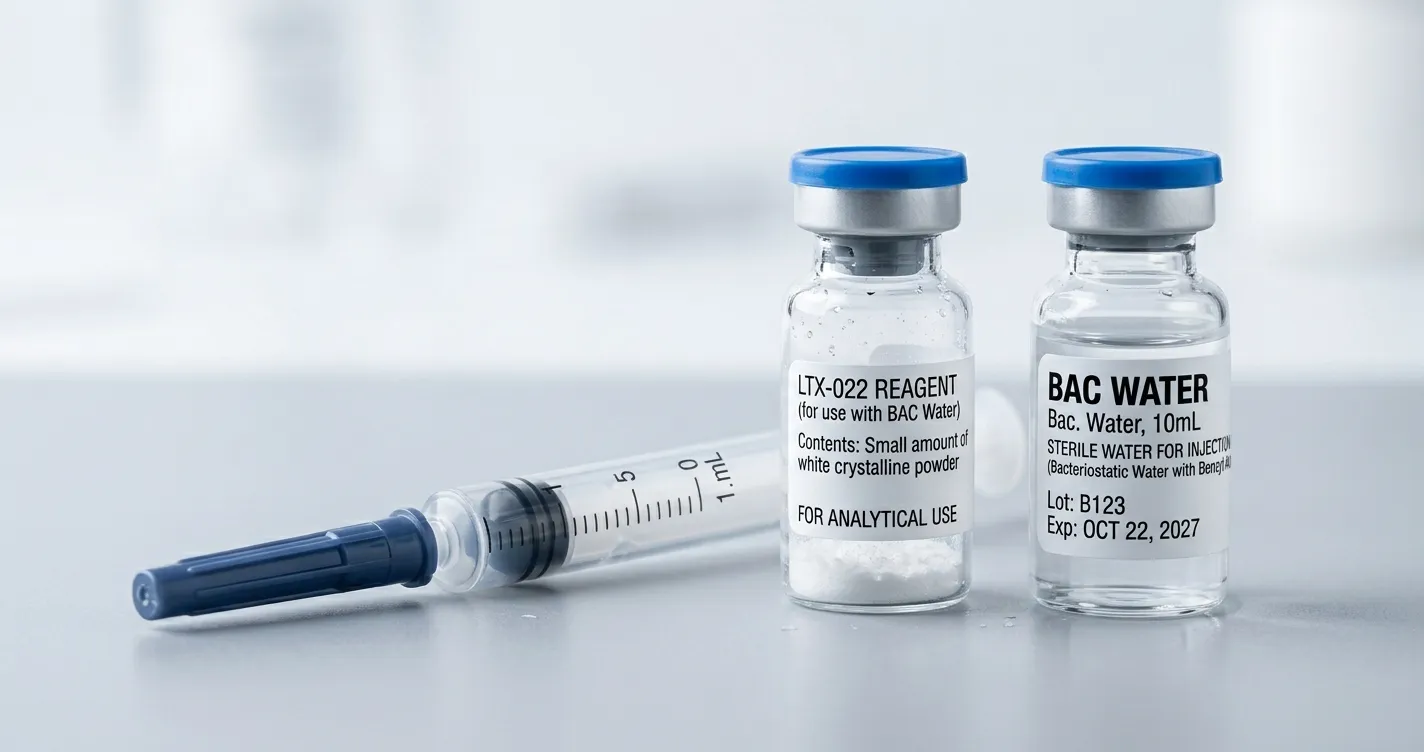
Bacteriostatic Water vs. Sterile Water vs. PBS for Peptide Research
This guide is strictly for laboratory and in vitro research purposes. Not for human or animal consumption. Not a medicine, food, cosmetic, or dietary supplement. Not approved by the MHRA.
Overview
The choice of reconstitution medium is a critical decision in peptide research. The three most common options are:
- [Bacteriostatic water](/product/bac) (BAC water): Sterile water with 0.9% benzyl alcohol
- Sterile water: Pure water (WFI grade) with no preservatives
- Phosphate-buffered saline (PBS): Buffered saline solution at pH 7.4
Each has distinct advantages, limitations, and appropriate use cases. This guide compares these media across key parameters to help researchers select the optimal solvent for their specific research model.
Bacteriostatic Water (BAC Water)
Composition:
- Sterile water (USP/EP grade)
- 0.9% (9 mg/mL) benzyl alcohol as a bacteriostatic preservative
- pH: 4.5–7.0 (slightly acidic)
- Osmolarity: ~300 mOsm/L (isotonic)
Advantages:
- Extended stability: Benzyl alcohol prevents bacterial growth, allowing reconstituted peptides to be stored for 7–14 days at 2–8 °C
- Standard for peptide research: The most widely used reconstitution medium for research peptides
- Isotonic: Does not cause osmotic stress in cell culture applications
- Cost-effective: Widely available and inexpensive
- Convenient: Eliminates the need for daily reconstitution
Limitations:
- Benzyl alcohol sensitivity: Some cell types (e.g., primary neurons, certain stem cells) are sensitive to benzyl alcohol at concentrations >0.5%
- pH range: Slightly acidic pH may affect pH-sensitive peptides or assays
- Not for all applications: Some regulatory protocols specify sterile water only
Best for:
- Standard cell culture assays
- Reconstitution of peptides for multi-day experiments
- General laboratory research where convenience is important
- Peptides that will be stored for 1–2 weeks after reconstitution
Sterile Water (WFI)
Composition:
- Pure water (USP/EP grade)
- No preservatives or additives
- pH: 5.0–7.0 (neutral)
- Osmolarity: ~0 mOsm/L (hypotonic)
Advantages:
- No additives: Ideal for sensitive cell types or assays where any additive could interfere
- Neutral pH: Better for pH-sensitive peptides or assays
- Regulatory compliance: Some protocols and SOPs explicitly require sterile water
- No solvent interference: No risk of benzyl alcohol affecting enzyme assays or receptor binding
Limitations:
- Short stability: No preservative means bacterial growth begins within 12–24 hours
- Must use immediately: Reconstituted peptides must be used the same day or discarded
- Hypotonic: Can cause osmotic stress in cell culture if not diluted into medium
- Inconvenient: Requires daily reconstitution for multi-day experiments
Best for:
- Same-day experiments
- Sensitive cell types (primary neurons, stem cells, certain epithelial cells)
- Enzyme assays where benzyl alcohol might interfere
- Assays requiring precise pH control
- Regulatory protocols specifying preservative-free reconstitution
Phosphate-Buffered Saline (PBS)
Composition:
- Sodium chloride (137 mM)
- Potassium chloride (2.7 mM)
- Sodium phosphate (10 mM)
- Potassium phosphate (1.8 mM)
- pH: 7.4 (physiological)
- Osmolarity: ~300 mOsm/L (isotonic)
Advantages:
- Physiological pH: pH 7.4 matches most cellular and biological environments
- Isotonic with cells: Does not cause osmotic stress
- Buffered: Resists pH changes during storage or incubation
- Standard cell culture buffer: Compatible with most cell culture media and assays
- No preservatives: Suitable for sensitive applications
Limitations:
- Short stability: Like sterile water, no preservative means bacterial growth within 24 hours
- Phosphate interference: Phosphate can interfere with some assays (e.g., phosphate detection, certain kinase assays)
- Salt content: High salt may affect some analytical methods (e.g., mass spectrometry, certain chromatographic separations)
- Not for long-term storage: Must use within 24 hours or prepare fresh
Best for:
- Cell culture applications where pH stability is critical
- Biological assays requiring physiological pH and ionic strength
- Reconstitution immediately before adding to cell culture medium
- Applications where benzyl alcohol is contraindicated but physiological pH is required
Comparison Table
| Parameter | Bacteriostatic Water | Sterile Water | PBS |
|---|---|---|---|
| Preservative | 0.9% benzyl alcohol | None | None |
| pH | 4.5–7.0 | 5.0–7.0 | 7.4 |
| Osmolarity | ~300 mOsm/L | ~0 mOsm/L | ~300 mOsm/L |
| Stability | 7–14 days at 2–8 °C | 12–24 hours | 12–24 hours |
| Cost | Low | Low | Low |
| Cell culture | Excellent (most cells) | Good (sensitive cells) | Excellent (buffered) |
| Convenience | High | Low | Low |
| Best for | Multi-day experiments | Same-day, sensitive cells | Cell culture, pH-critical |
Decision Tree:
- Will the peptide be stored >24 hours after reconstitution?
- Yes → Bacteriostatic water
- No → Proceed to question 2
- Are you working with benzyl alcohol-sensitive cells?
- Yes → Sterile water or PBS
- No → Proceed to question 3
- Is physiological pH critical for your assay?
- Yes → PBS
- No → Bacteriostatic water or Sterile water
- Is your assay sensitive to phosphate or salts?
- Yes → Sterile water
- No → PBS or Bacteriostatic water
Practical Recommendations
For Most Research Applications:
Bacteriostatic water is the default choice for peptide reconstitution. It provides the best balance of stability, convenience, and cost for standard cell culture and biochemical assays.
For Sensitive Cell Types:
Primary neurons, certain stem cells, and some epithelial cells are sensitive to benzyl alcohol. For these applications:
- Reconstitute in sterile water or PBS
- Use immediately (within 4–6 hours)
- Prepare fresh solutions for each experiment
For Mass Spectrometry or Analytical HPLC:
- Reconstitute in sterile water or a compatible organic solvent (e.g., acetonitrile, methanol)
- Avoid PBS (salt interferes with MS ionisation)
- Avoid BAC water (benzyl alcohol may appear as an artifact in chromatograms)
For Animal Research (if applicable):
- Consult institutional veterinary protocols
- Some protocols require sterile water or PBS specifically
- Document the rationale for solvent choice in your IACUC or ethics application
For Long-Term Studies:
If a study requires peptide administration over multiple days:
- Reconstitute in BAC water and store at 2–8 °C
- Verify stability by HPLC at the beginning and end of the study
- Consider aliquoting into single-day vials to minimise contamination risk
Storage of Unused Solvent:
- BAC water: Store at room temperature (15–30 °C), protected from light. Use within the expiry date (typically 12–24 months from manufacture).
- Sterile water: Store at room temperature. Use within 24 hours of opening if not used completely.
- PBS: Store at 2–8 °C. Use within 24–48 hours of opening or prepare fresh from powder.
Manufacturing and Quality Control
Bacteriostatic water is manufactured under pharmaceutical-grade conditions to ensure sterility and consistency. The production process involves several critical steps:
1. Water Purification
Source water undergoes reverse osmosis, deionisation, and distillation to achieve USP/EP-grade purified water with resistivity ≥18.2 MΩ·cm. This removes minerals, organic compounds, and microbial contaminants.
2. Sterile Filtration
The purified water is passed through a 0.22 µm sterilising-grade filter to remove bacteria and particulate matter. This is typically performed in a classified cleanroom environment (Grade A/ISO 5 or equivalent).
3. Benzyl Alcohol Addition
USP-grade benzyl alcohol is added at 0.9% (9 mg/mL) as a bacteriostatic preservative. The exact concentration is verified by HPLC or gas chromatography. The benzyl alcohol must meet USP specifications for purity (≥99.0%) and identity.
4. Filling and Sealing
The sterile solution is filled into multi-dose vials under aseptic conditions. Vials are sealed with rubber stoppers and aluminium crimps. Each vial is visually inspected for cracks, particulate, and fill volume. Some manufacturers also terminally sterilise by autoclaving at 121 °C for 15 minutes.
5. Quality Control Testing
Each batch undergoes:
- Sterility testing per USP <71> or Ph. Eur. 2.6.1
- Endotoxin testing (LAL assay, Ph. Eur. 2.6.14) — typically <0.5 EU/mL
- Benzyl alcohol assay — confirm 0.9% ± 0.1%
- pH testing — confirm 4.5–7.0 range
- Particulate matter per USP <788> or Ph. Eur. 2.9.19
- Container-closure integrity — leak test
Batch Release:
A Certificate of Analysis is issued for each batch documenting all test results. Reproducible research depends on using BAC water from a consistent source with documented quality control.
Shelf-Life and Storage Best Practices
Proper storage of bacteriostatic water is essential to maintain sterility and preservative efficacy.
Unopened Vials:
- Shelf life: Typically 12–24 months from manufacture date
- Storage conditions: Room temperature (15–30 °C), protected from light
- Do not freeze: Freezing can cause vial cracking and rubber stopper degradation
- Inspect before use: Check for cracks, cloudy solution, or particulate
Opened (In-Use) Vials:
- Multi-dose window: 28–30 days after first puncture per USP standards
- Storage: Room temperature in original packaging, away from direct light
- Alcohol swab: Always wipe the rubber septum with 70% isopropyl alcohol before inserting a needle
- Needle size: Use a 25G–30G needle to minimise stopper coring
- Label: Write the opening date on the vial to track the 28-day window
Visual Inspection Guide:
| Observation | Likely Cause | Action |
|---|---|---|
| Clear, colourless | Normal | Safe to use |
| Cloudy or hazy | Microbial contamination | Discard immediately |
| Particulate or flakes | Stopper degradation or glass | Discard; inspect remaining vials |
| Yellow tint | Benzyl alcohol degradation | Discard if >30 days old |
| Crystals/precipitate | Contamination or freezing | Discard |
When to Discard:
- Beyond the manufacturer's expiry date
- More than 28–30 days after first opening
- Any visible cloudiness, particulate, or discolouration
- If the vial seal is broken or the crimp is loose
- If stored outside 15–30 °C for extended periods
Volume Selection Guide
Choosing the right volume of bacteriostatic water depends on the peptide mass in the vial and the desired concentration for your research protocol.
General Guidelines by Vial Size:
| Vial Content | Recommended BAC Water | Resulting Concentration |
|---|---|---|
| 2 mg peptide | 0.5–1 mL | 2–4 mg/mL |
| 5 mg peptide | 1–2 mL | 2.5–5 mg/mL |
| 10 mg peptide | 2–4 mL | 2.5–5 mg/mL |
| 15 mg peptide | 3–6 mL | 2.5–5 mg/mL |
| 20 mg peptide | 4–8 mL | 2.5–5 mg/mL |
| 30 mg peptide | 6–10 mL | 3–5 mg/mL |
| 50 mg peptide | 10–15 mL | 3.3–5 mg/mL |
Key Considerations:
- Minimum volume: Use at least 0.5 mL of BAC water per vial to ensure complete dissolution. Smaller volumes may not fully wet the lyophilised plug.
- Maximum volume: Do not exceed the vial's recommended fill volume. Overfilling can cause stopper leakage and contamination.
- Concentration targets:
- 2–5 mg/mL: Standard range for most research peptides
- 5–10 mg/mL: Concentrated stock for subsequent dilution into assay buffer or culture medium
- <1 mg/mL: Use for highly potent peptides or when larger injection volumes are acceptable
- Solubility factors: Some peptides have poor aqueous solubility at high concentrations. If the peptide does not dissolve readily, use a larger volume (lower concentration) or consult the peptide's solubility data sheet.
- Practical tip: For most standard research protocols, 2 mL per 10 mg peptide is a safe starting point. Use the Peptide Calculator to fine-tune volumes and verify concentrations.
Frequently Asked Questions
Browse our catalog of research-grade peptide reference materials. All products include batch-specific Certificates of Analysis and are shipped from the UK.
For laboratory and in vitro research use only. Not for human consumption. Not a medicine. Nothing in this guide constitutes medical advice. UK researchers are responsible for compliance with the Human Medicines Regulations 2012 and Misuse of Drugs Regulations 2001 where applicable.